自己破壊芸術展 / An Exhibition of Auto-Destructive Art
NEORT++ is pleased to announce the group exhibition, "An Exhibition of Auto-Destructive Art."
Statement
Creation has often been described as a process of bringing forth the new, giving form, and adding to what exists. Destruction, by contrast, is cast as the opposite of production: a reduction in value, a loss. In this view, creation is a positive force and destruction a negative one. Yet in living organisms and ecosystems, death and destruction are integral to the functioning of the whole. In art, too, destruction has served to dismantle established forms and values, opening the way to new modes of expression. From this perspective, creation and destruction are not simple opposites, but parts of a single process unfolding through time, each entwined with the other.
An Exhibition of Auto-Destructive Art reconsiders destruction as a process equal to creation, rather than a negative ending. At the moment a work collapses of its own accord, its material appears not as something to be preserved, but as an event in continual change. Rather than moving toward completion, the work changes irreversibly, continually passing into different states. In this sense, the exhibition also presents each work not as a static, finished object, but as a “site” that holds time and change within it.
The exhibition takes as its point of departure “Auto-Destructive Art,” a concept proposed by Gustav Metzger in 1959. Having escaped Nazi persecution and gone to Britain, Metzger confronted the destructive forces of nuclear weapons, mass production, capitalism, and technological development in postwar society. He conceived an art in which the work itself would disappear over time. Destruction was not something that befell the work by chance from outside. Changes such as corrosion, disintegration, and disappearance were built into the work’s structure from the outset, and their unfolding constituted the work. For Metzger, self-destruction was also a way to expose society’s “self-destructive tendencies” by setting them in motion within art.
This exhibition seeks to reconsider Auto-Destructive Art in today’s decentralized computing environments. On a blockchain, a work need not exist solely as a fixed object: it can run as code, be recorded through transactions, and persist while changing state. An action, once executed, may be impossible to reverse. Conditions can change over time, and a program can even contain the conditions for its own disappearance or transformation. The structure Metzger introduced into material works—a work that changes of its own accord and is ultimately lost—can thus be implemented as a property of computation itself.
The exhibition treats these features of decentralized computing environments not merely as a technical backdrop, but as an opportunity to reconsider the form of art itself: structures that do not depend on the permanence of materials; the irreversible accumulation of time; works that exist as ongoing processes; and conditions for change or disappearance built into the works themselves. Taking Metzger’s conception of Auto-Destructive Art from more than half a century ago as its starting point, the exhibition explores, through the practices of its participating artists, how creation and destruction might come together in computational environments to give rise to new forms of art.
Artworks
Alerting Infrastructure!
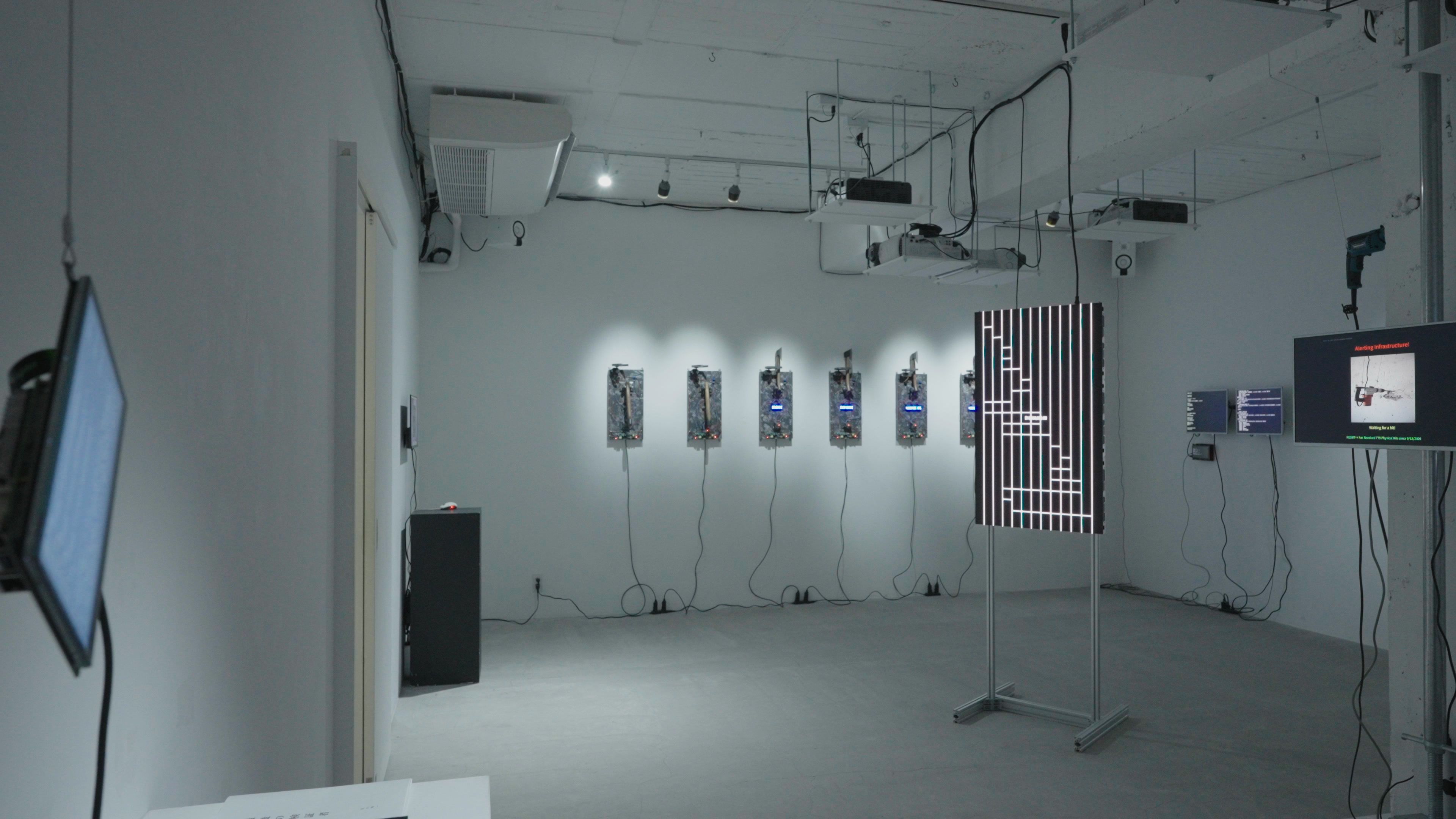
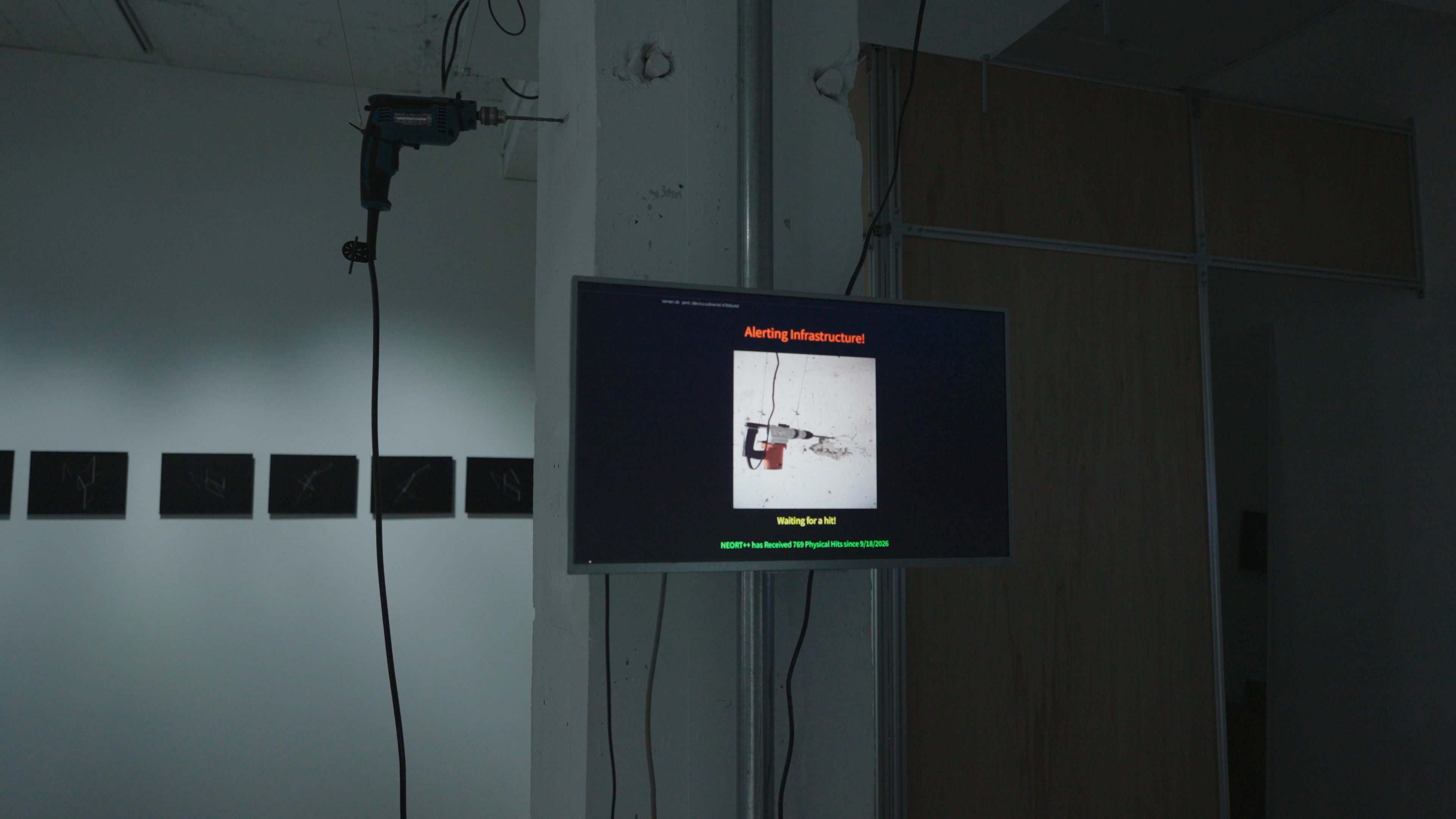
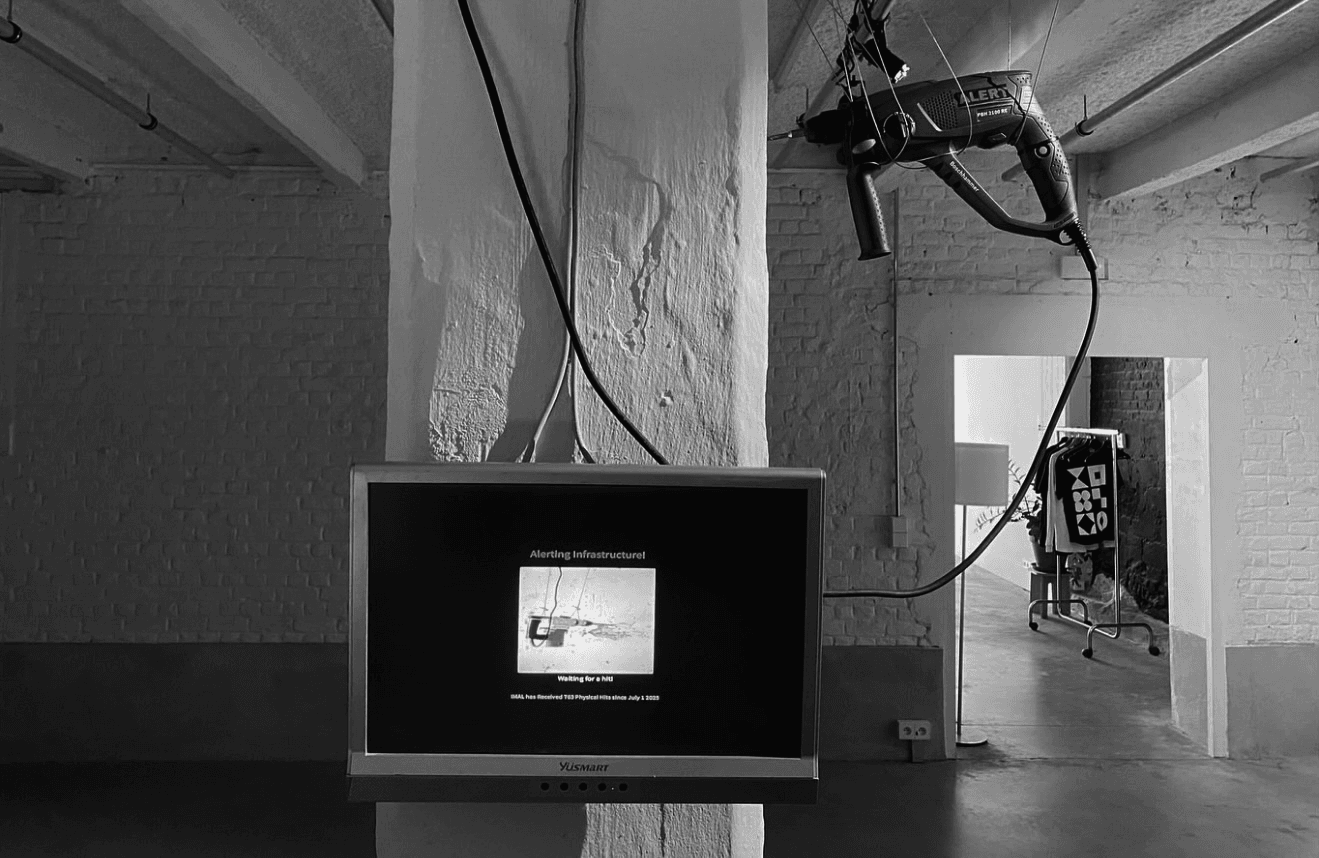
View artworkAlerting Infrastructure! is a physical hit counter that translates hits to the web site of an organization into interior damage of the physical building that web site or organization represents. The focus of the piece is to amplify the concern that physical spaces are slowly losing ground to their virtual counterparts. The amount of structural damage to the building directly correlates to the amount of exposure and attention the web site gets, thus exposing the physical structure’s temporal existence.
Hatch/et
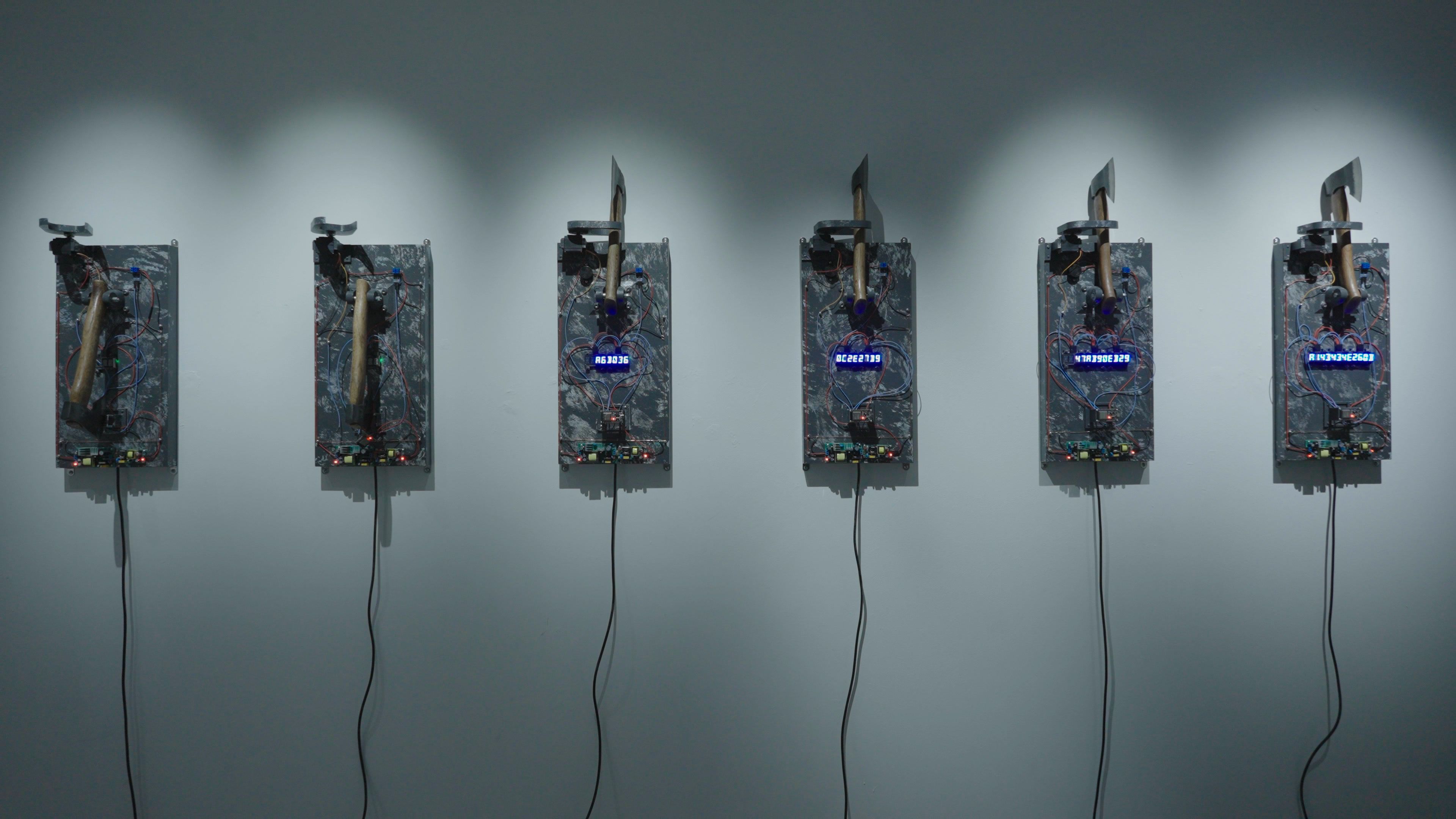
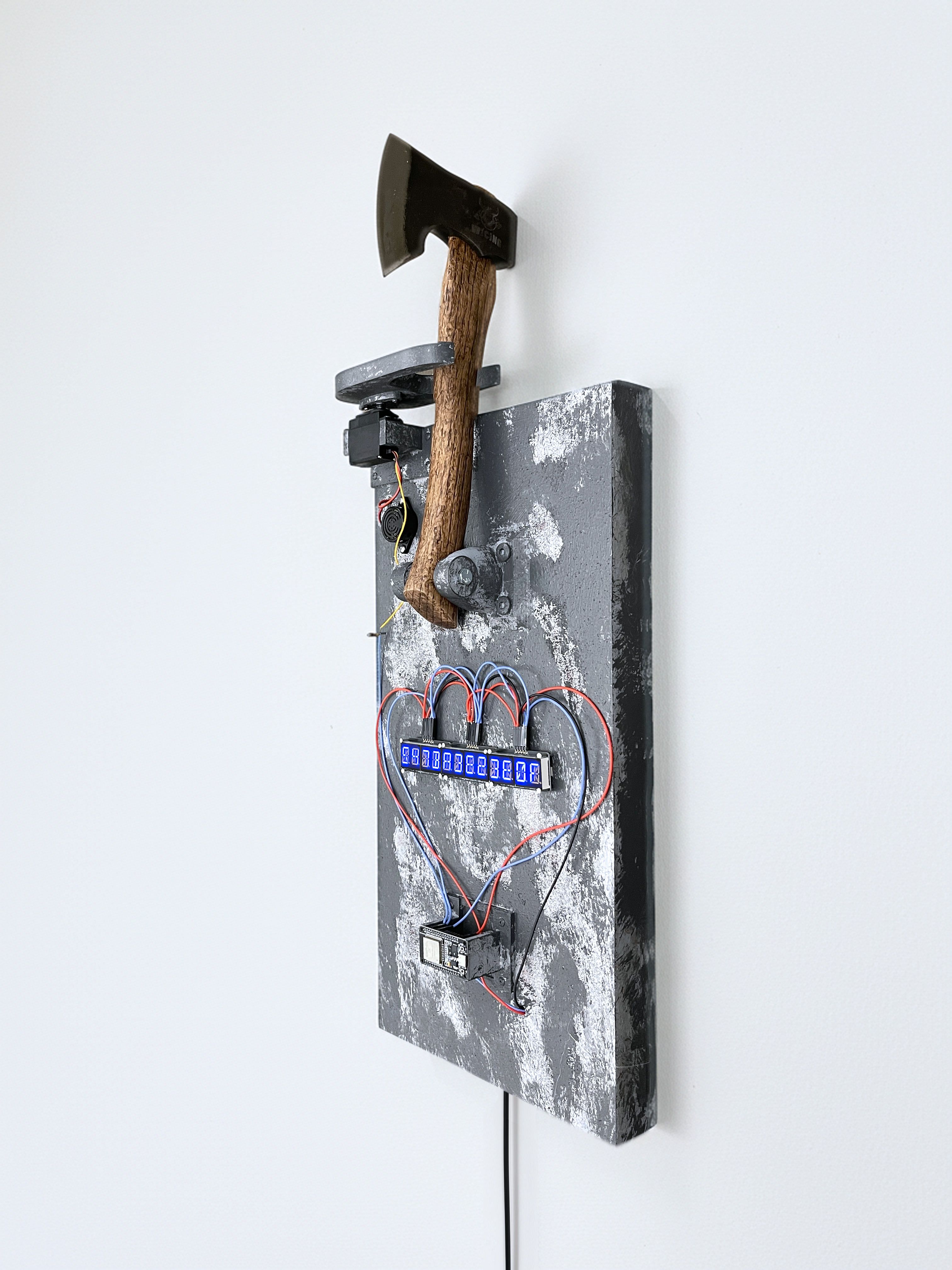
View artwork"Hatch/et" is an artwork in which a computer attached to the bottom of the piece continuously launches random brute-force attacks on a set passcode, and the moment it is decrypted, the work destroys itself with an axe. A passcode with a different number of digits is set for each object, resulting in varying levels of difficulty. Some are solved in under a minute on average, while others require an average of 150,000 years. Mass-produced computers, created as replaceable entities, are elevated to irreplaceable existences (unique destroyed objects) the moment they encounter their one-and-only code. It is a work where the acquisition and disappearance of individuality overlap at the exact same moment.
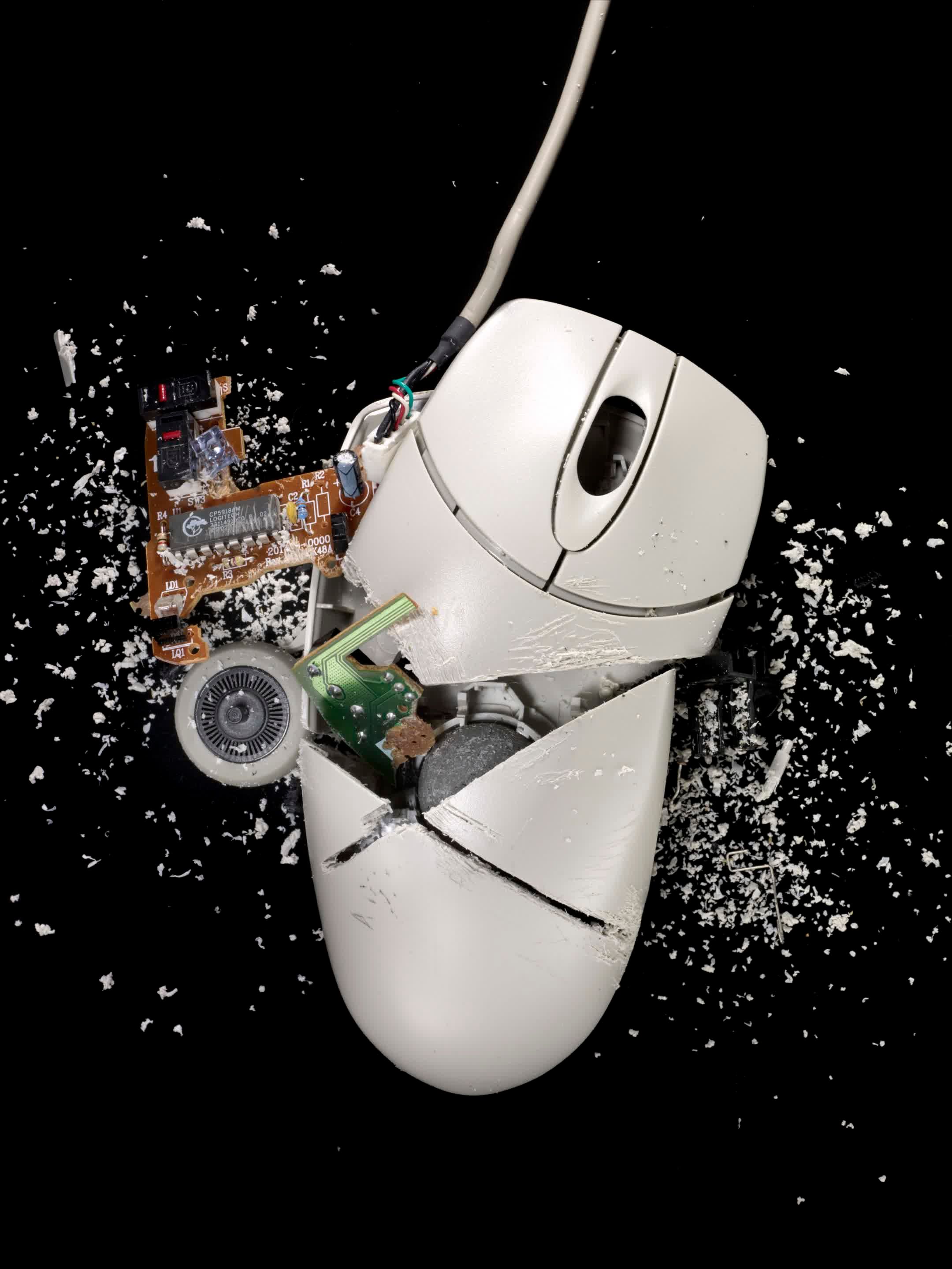
断末魔ウス
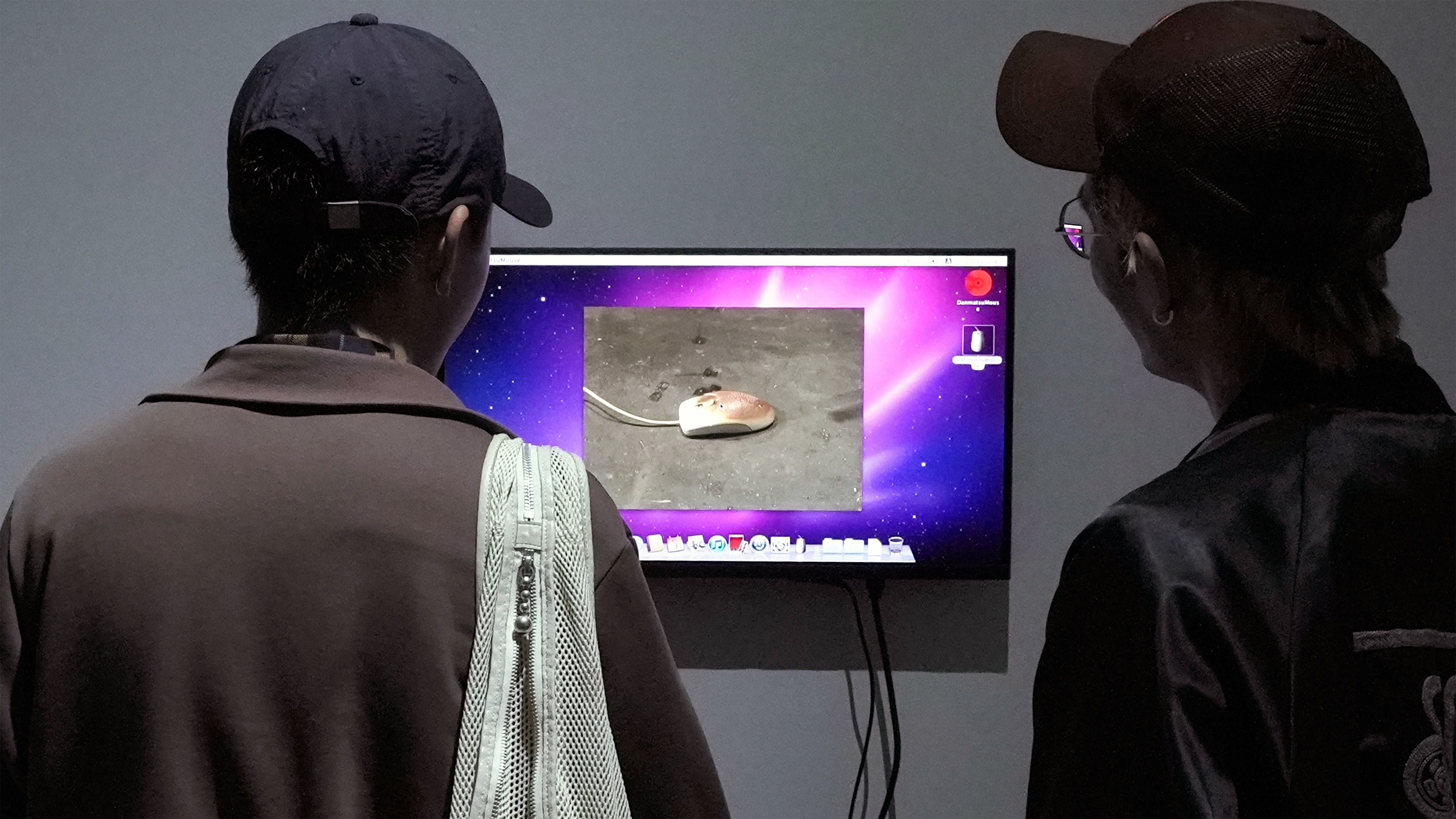
View artworkA software artwork featuring footage of a mouse being destroyed, along with a recording of the desktop cursor's movements from that moment. When the work is launched, video of the mouse being destroyed plays alongside your own desktop mouse cursor, which replicates the movements made at the time of the actual destruction. While the physical mouse cannot be restored once destroyed, the digital cursor (the arrow) can come back to life again and again, repeating the same movements. This work contrasts physical death with digital death.
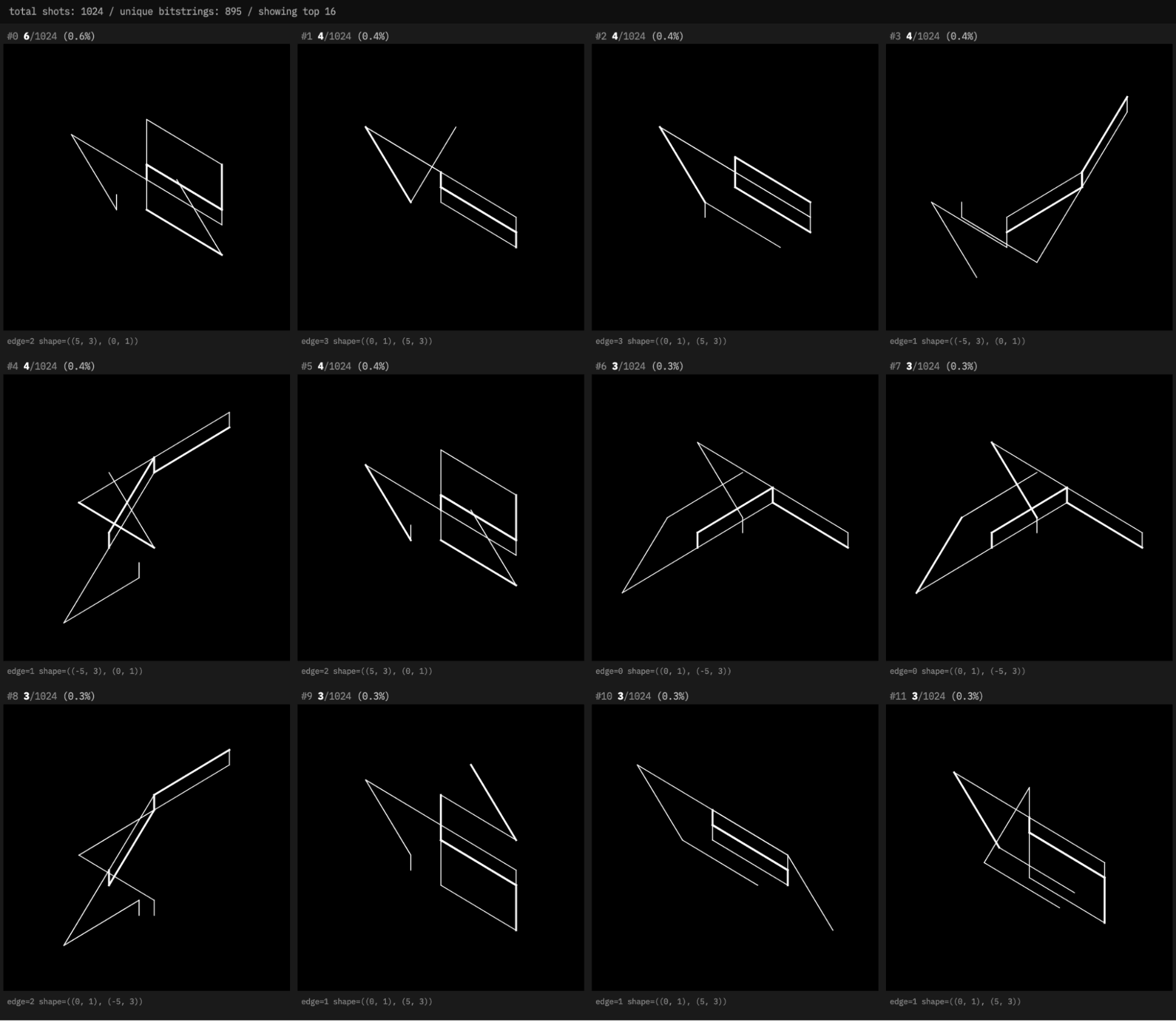
Collapsed Constellations ─ 崩壊した星座
View artworkMeasurement-Based Quantum Computation (MBQC) proceeds by preparing a highly entangled quantum state known as a cluster state and then measuring its qubits sequentially. In contrast to gate-based quantum computation, in which quantum operations are applied step by step to an initial state, MBQC computes by progressively dismantling an entangled collection of qubits through measurement. Because measurement irreversibly consumes entanglement and does not allow the process to be reversed, MBQC is also known as one-way quantum computation.
In “Structural Constellations” (1948–66), Josef Albers explored the ambiguity of the visual world and the multiplicity of spatial perception. Although these planar figures are composed entirely of straight lines, multiple viewpoints coexist within them. When the viewer attempts to read them as three-dimensional forms, the same line may appear to project forward or recede into depth. Albers selectively emphasized certain lines while eliminating others. Through this operation, multiple planes, volumes, and movements emerge simultaneously from a single figure.
This work connects the destructive indeterminacy of quantum measurement with the generative ambiguity of Albers’s figures. A one-dimensional linear quantum cluster, in which countless constellations remain latent, and a two-dimensional lattice cluster based on the construction rules of kolam, the traditional floor drawings of South India, are collapsed through measurement. From the resulting measurement outcomes, ambiguous geometric poems composed solely of straight lines are constructed. The computation was carried out on a superconducting quantum computer at Osaka University’s Center for Quantum Information and Quantum Biology (QIQB), accessed through the open-source quantum cloud software OQTOPUS.
Special Thanks: Makoto Negoro and Takafumi Miyanaga, Center for Quantum Information and Quantum Biology (QIQB), The University of Osaka / Keisuke Inoue, FabLab KandaNishikicho
Poesia Povera ─ 削ぎ落とされた詩
View artworkIn “Regular Expressions as a System of Poetic Notation” (2008), the American poet Dan Waber declared: “Words fail.” This is not a failure of communication but an ontological failure. Experience and sensation are multidimensional, simultaneous, ambiguous, and contradictory. Language, by contrast, arranges signs sequentially, one word and one sentence at a time. It reduces the richness of experience to a sequential string of characters. This failure of language has been one of the driving forces of poetry. Poetry has expanded not only by refining, rearranging, and inventing words, but also by turning letters into figures, spatializing language, and making language increasingly parallel and distributed.
Regular expressions use metacharacters to describe patterns in strings for searching, replacing, and extracting text. They can inscribe multiple possibilities simultaneously within a single sequence of symbols. The regular expression li[sf]t, which can match both list and lift, superimposes the two words. In this sense, regular expressions partially loosen the constraint of language that permits us to say only one thing at a time.
The metacharacters of regular expressions correspond to poetic techniques. Alternation, |, transforms Jakobson’s paradigmatic axis into the syntagmatic axis. The quantifiers ?, *, and + correspond to repetition and refrain, while the backreference \1 corresponds to anaphora and rhyme. Expressions such as ^, $, and (?!…), which specify conditions, direct the course of execution. Regular expressions thus shift from a means of specifying search conditions to a system of poetic notation.
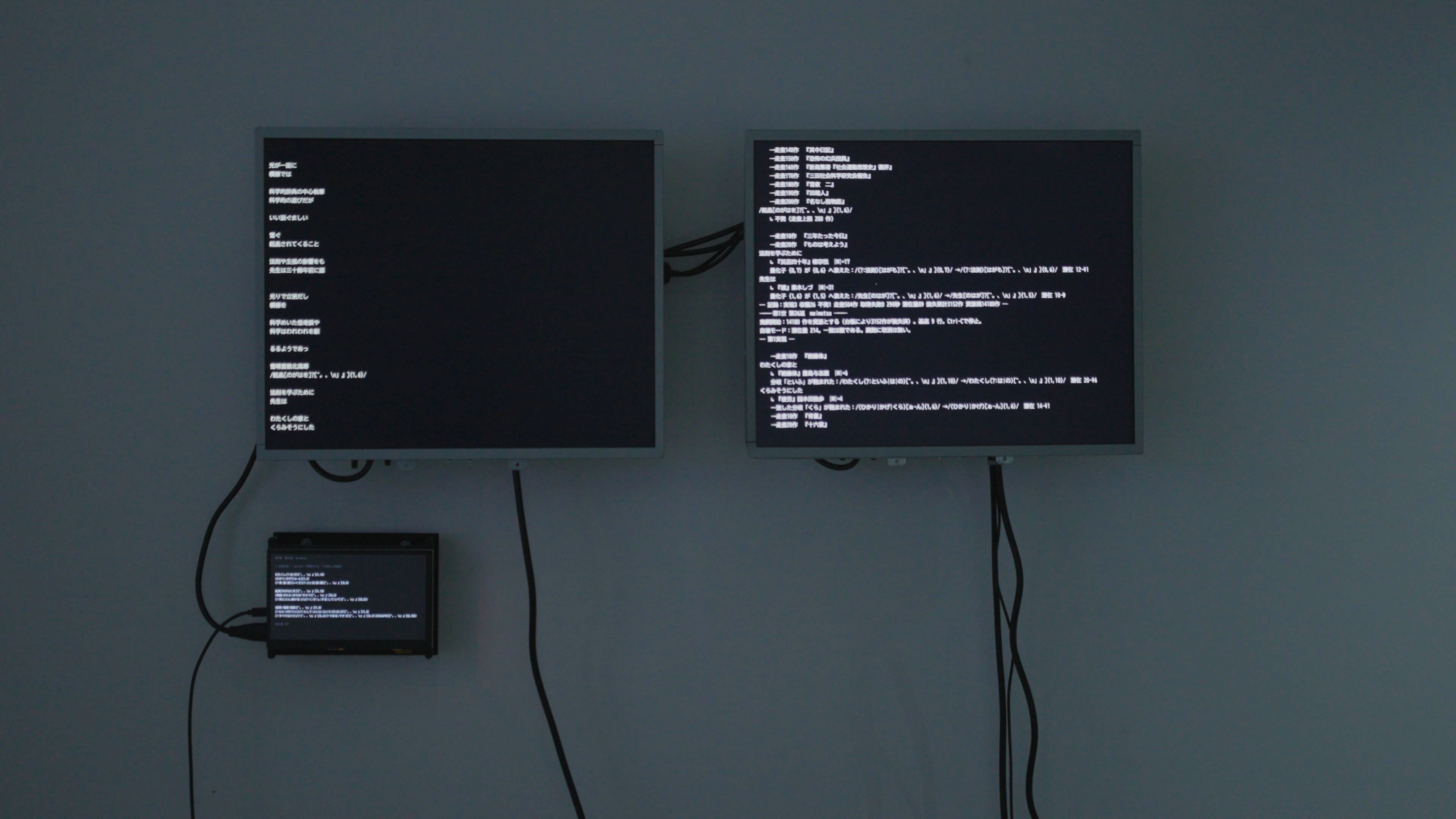
The work composes poetry by following the process of measurement-based quantum computation. Its computational resource, corresponding to a quantum cluster, consists of public-domain works from Aozora Bunko. A work is selected at random, and a poem written as a regular expression is applied to it as a measurement basis. The fragments of text that it captures are displayed and read aloud in electronic speech. The captured words are then substituted into the next basis, altering what will be measured next. Just as measurement itself constitutes computation in measurement-based quantum computation, reading becomes, in itself, an act of writing.
Five regular-expression poems have been prepared. Throughout the exhibition, these poems serve as trawling nets, ceaselessly dragged through the sea of Aozora Bunko.
Flicker Score (meimetsu.regex) — Kenji Miyazawa
Nonwar Score (hisen.regex) — Akiko Yosano
The Fact of Anarchy (museifu.regex) — Noe Itō
Slime Mold Score (nenkin.regex) — Kumagusu Minakata
Science and Art Score (kagakugeijutsu.regex) — Torahiko Terada and Ukichiro Nakaya
Gustav Metzger’s Auto-Destructive Art contains within the work itself the agents of its own destruction. The work disintegrates within a finite period of time, and once its destruction is complete, its remains are removed from the site. This work likewise corrodes with every fragment it cuts away from its resources, as though another drop of acid had fallen upon it. A work that has matched any of the five poems is entered into a register of consumed works and can never again be used as a resource for poetic composition. Once all resources have been exhausted, the register and the state of corrosion are reset, and the next generation begins.
Execution Example: Nonwar Score
To examine you closely
my younger brother
even our parents, I wish, would refrain
Night will soon come
toward spring
innately, without shame
life
Thou shalt not
Even if you are staying there
having lost his two beloved children at Port Arthur
the parent
All who understand the value of culture
because of the spring wind
your lordship’s eyes, perhaps
the act of serving you, unfin—
thou shalt not
Away from your side
among the forces besieging Port Arthur
a dear memory was
I am thinking that
it was early spring
a love story, exceedingly
the beloved landscape is Enshū
unlike “thou shalt not,” this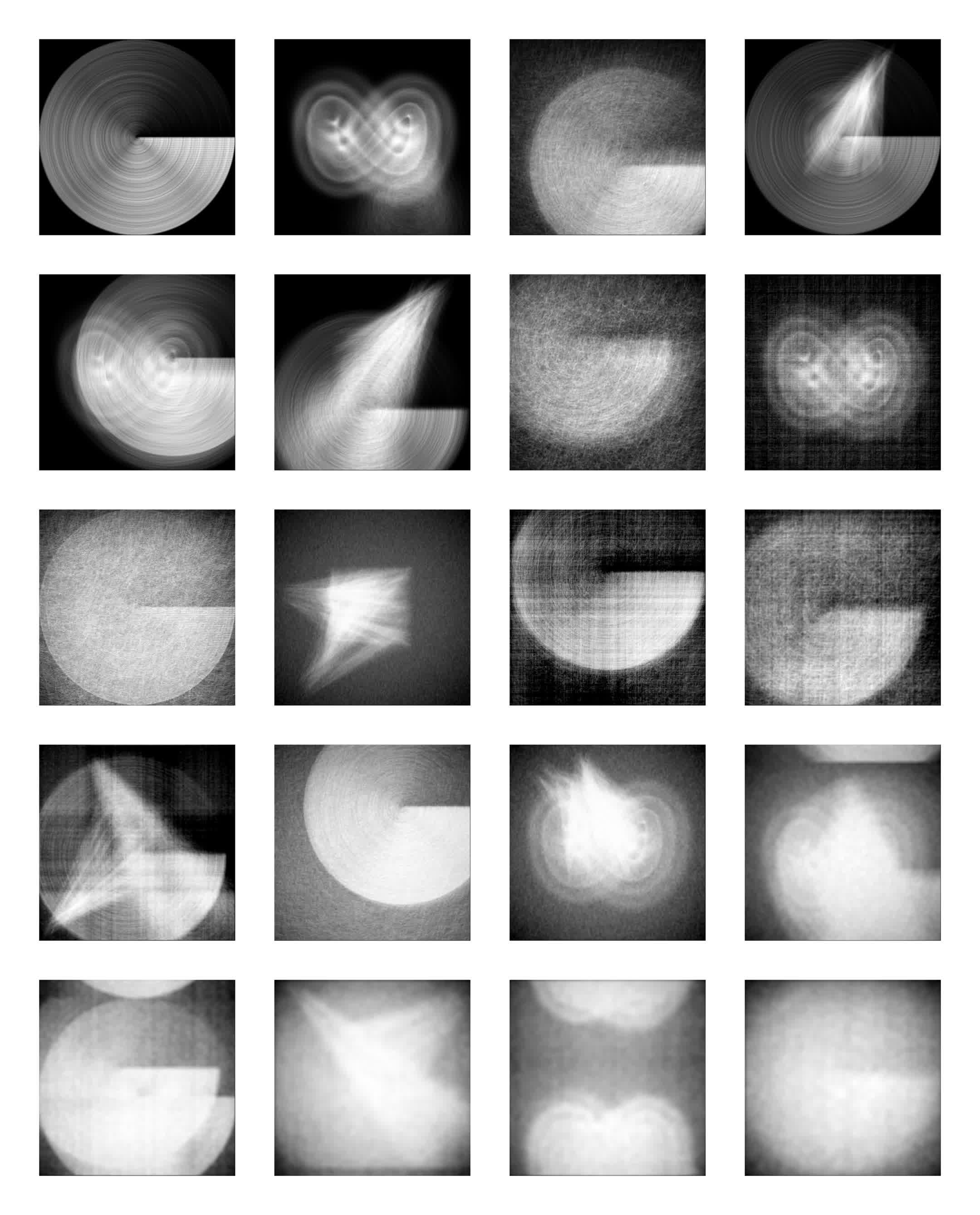
Entropy
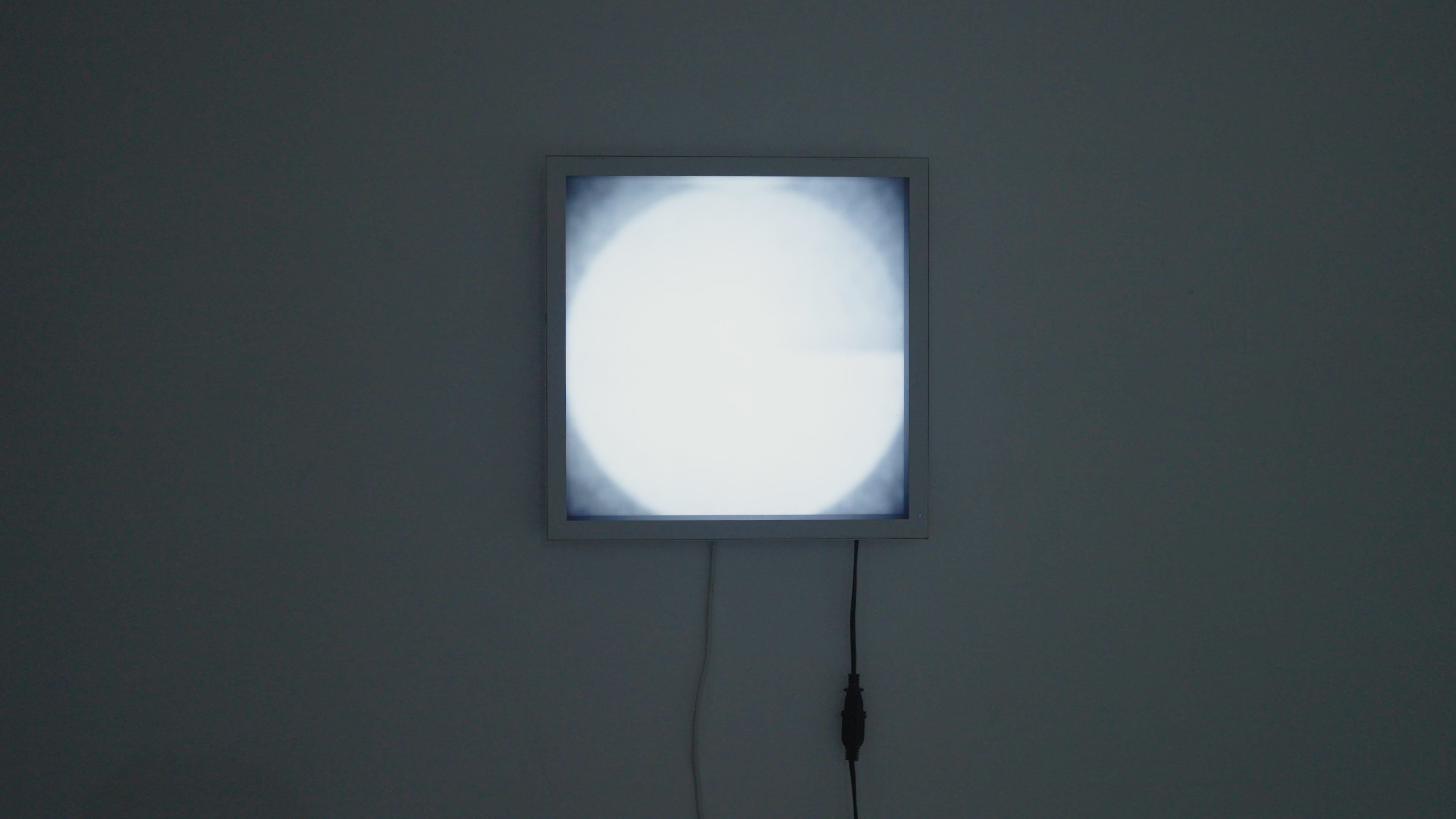
View artworkEntropy is an audiovisual generative artwork. The system of instructions that generate the artwork are stored “permanently” on the Ethereum blockchain, guaranteeing its existance, and yet also implementing it’s eventual destruction. Every time the NFT token is transferred, those instructions implement an artifical system of degradation, causing the artwork to degrade in a similar mannger to the generation loss that occurs when analog media is repeatedly copied. Note the process is artificial, in that no information is actually lost. The code model itself is stored publicly and immutably on a decentralized network, and the output media can be reconstructed in any state. And yet, people still treat Entropy tokens are depending on it’s recorded number of transfers. So you still have this social construction, or destruction of value, despite its artifice (doesn’t actually degrade). Permanence (immutability) is a central theme of blockchain, a dogma of its culture, and at best an illusion. Entropy explores the theme of blockchain permanence paradoxically by storing code to describe an artificially impermanent system.
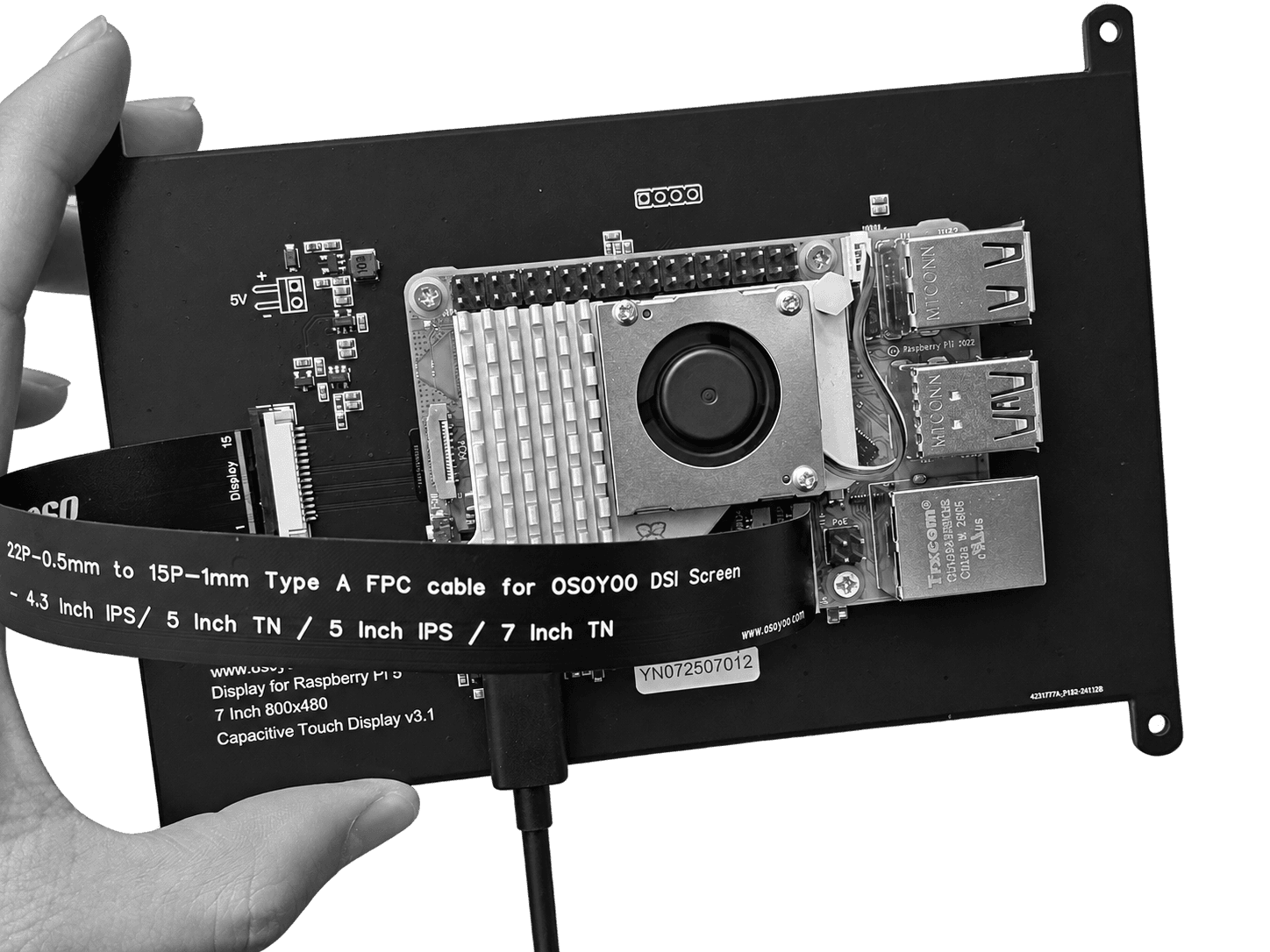
assumevalid
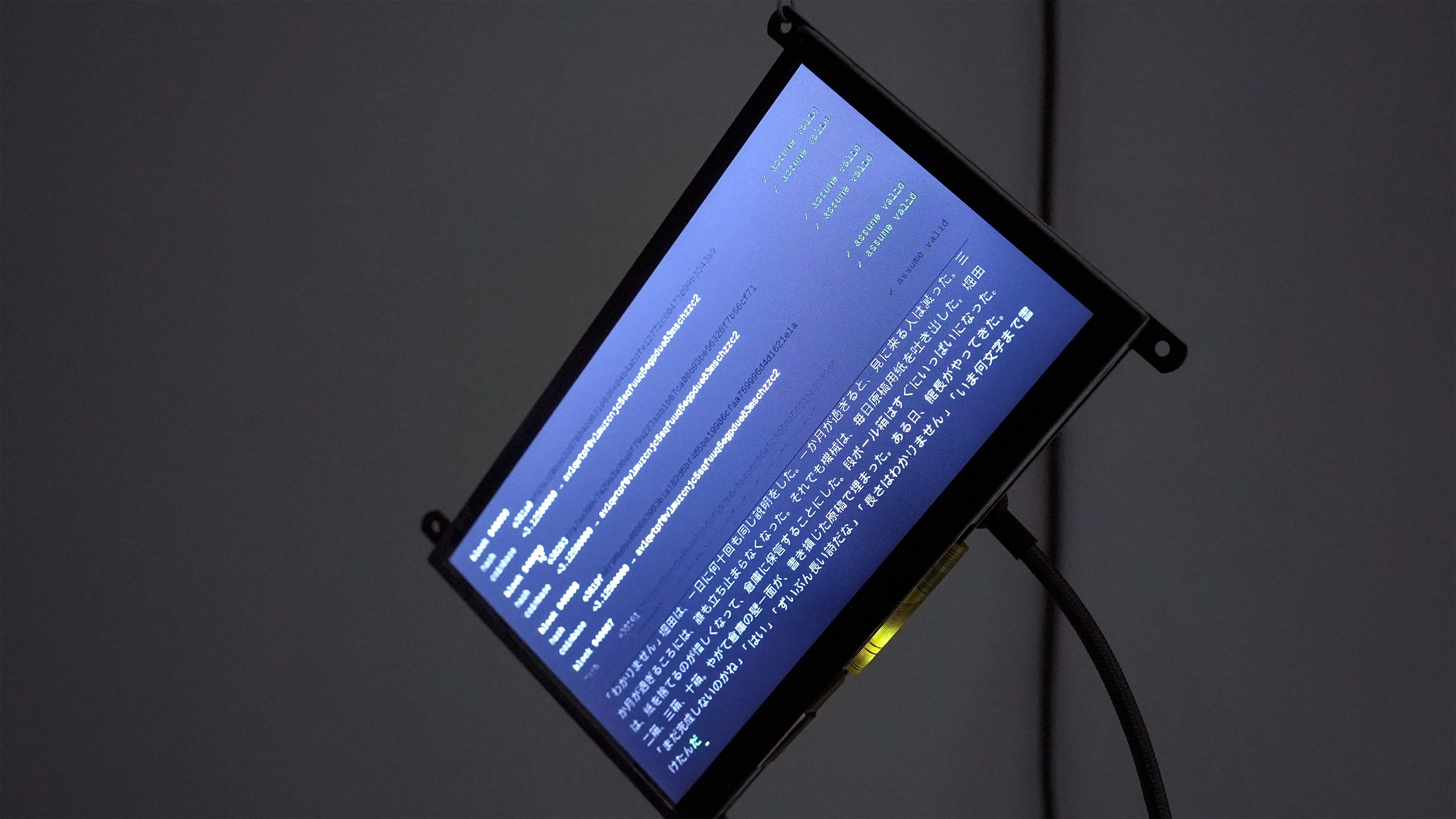
View artwork"assumevalid" is a blockchain that permits not verifying. In this blockchain network, it does not check whether written records are valid. It does not recalculate the hash values of blocks. It does not check script results either. Transactions that send non-existent assets are accepted as they are. The name comes from a real setting called "assumevalid" found in Bitcoin nodes. The source code is publicly available, allowing anyone to run the same software and join the network.
In the installation, a single node participating in the network is on display. Mining is performed on the displayed node, constantly proposing new blocks. Deciphering the mining results reveals the text of a certain novel. The node repeats hash calculations, continuously searching until the result corresponds to the next character of the novel. Non-matching results are discarded, and once a character is found, it moves on to the next one. There is no need to perform this calculation. There is no reward. It does not make the network secure, either. And the network does not check whether the calculations were actually performed. Even so, the node continues to calculate.
Destruction does not necessarily manifest as a stop or disappearance. The system continues to run, and on the surface, it appears as though nothing has happened. On the other hand, the rules and consensus that had supported it until then have subtly changed into something else. In "assumevalid" as well, the blockchain continues to run. However, the principle that established its existence—verifying records—is broken. In a world pretending to be consistent, a single node nevertheless continues calculations that are requested by no one and verified by no one. In modern times, what does it mean to still remain sincere?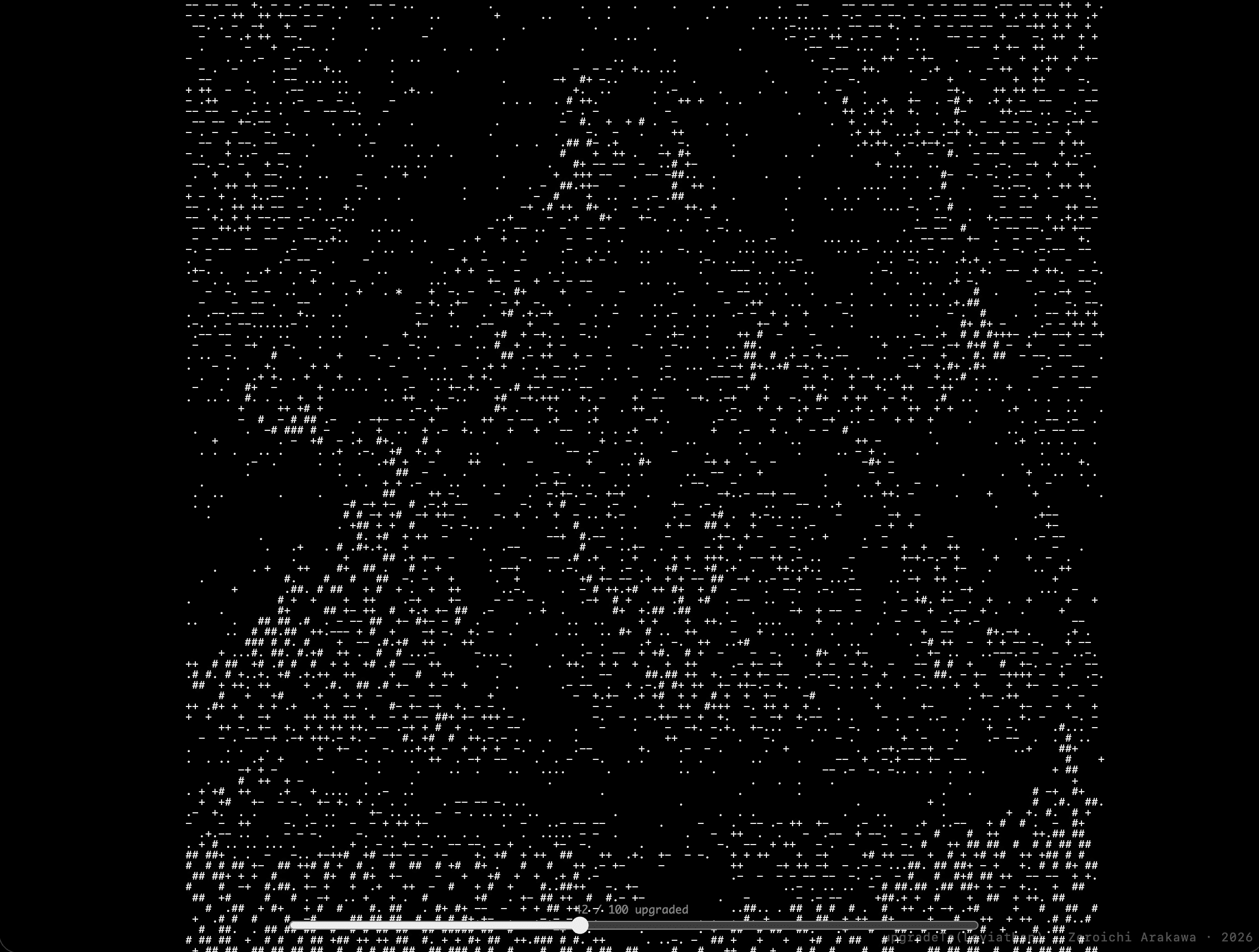
upgradeTo(Leviathan)
View artworkupgradeTo(Leviathan) consists of one hundred upgradeable smart contracts on Ethereum and a single ERC-721 token. Each contract is named “citizen” and holds its own data. Each citizen draws thirty points from its data, and the points of all hundred overlap to form a landscape resembling a starry sky on screen.
upgradeTo()is a function that replaces only the implementation code, leaving the address and data as they are. It is used to fix vulnerabilities or respond to regulation. In this work, once the time set for each citizen has passed, anyone can call that citizen’sexecute(). The citizen switches to a different implementation, and the caller receives the ETH the citizen held as a reward.
The data each citizen holds does not change before or after the switch. The earlier code reads it as stars; the later code reads the same data as a fragment of a body based on the frontispiece of Hobbes’s Leviathan. The data of the hundred citizens has contained both the starry sky and Leviathan from the beginning.
Each implementation to be switched to contains a single function taken from existing stablecoins and protocols: blacklisting, asset freezing, identity verification, taxation, and others. Only the owner of the token can further replace the implementation of a citizen that has switched. That authority widens as the transitions proceed.
Ethereum and the applications running on it have undergone repeated revisions as they have come into wider use in society. Each change can be read as eroding decentralization, or as a necessary compromise. Whether the whole that these transitions add up to is becoming something like a monster cannot be seen from any single transition.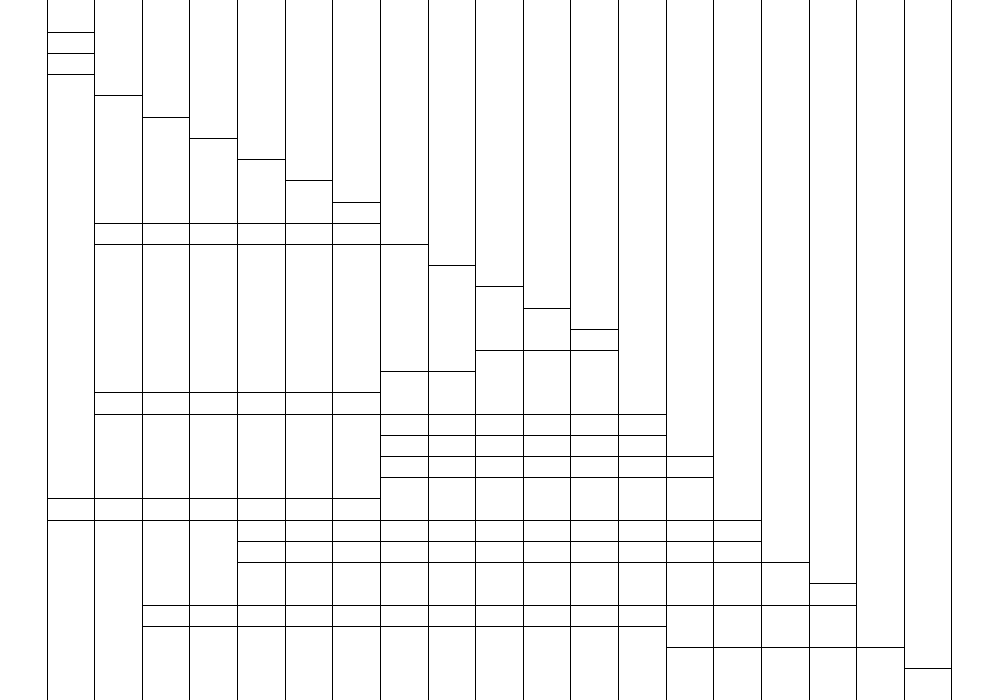
Diminishing Returns, 2026 (From the transaction sculpture series)
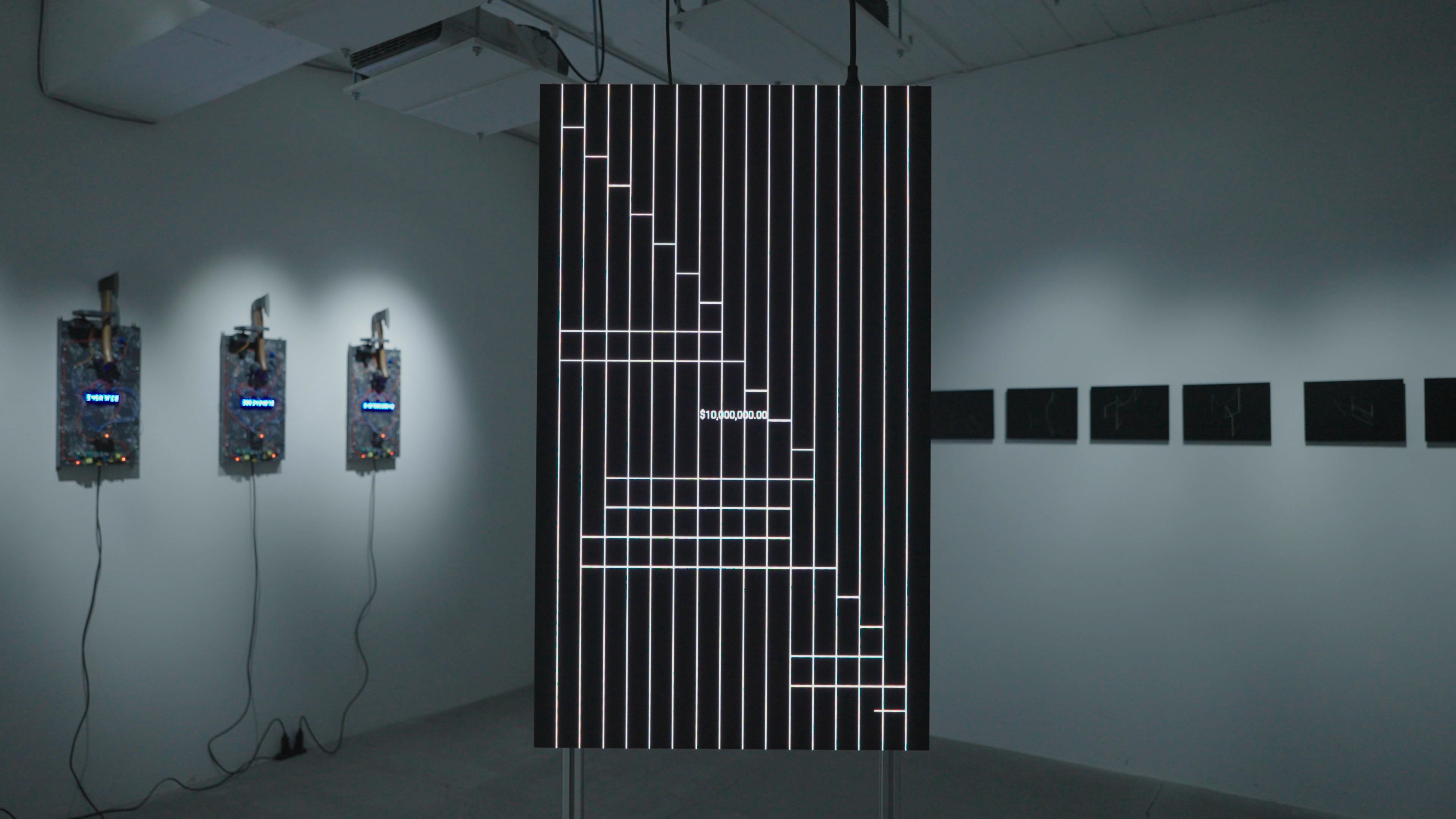
View artworkTransaction sculptures consist of an arrangement of smart contracts that forward transactions to other contracts (or themselves) in unique ways. Every activation of a sculpture will yield a different result. All sculptures are unique and can be activated by anyone by sending a small amount of ETH to the address of the sculpture. Vertical lines represent contracts and horizontal lines represent the transfers between them. The complete visual arrangement is one transaction – the most recent one.
The piece "Diminishing Returns" consists of thirty-two contracts that forward transactions between each other. Each transfer wears down the connection it uses. With repeated use, the transactions tend to take shorter paths, while the amount of ETH sent through the sculpture is returned in full. Random changes can redirect connections or make worn-out ones usable again. The sculpture also decays with elapsed time, with this decay applied at the next activation.
Diminishing Returns is a unique work in the Transaction Sculptures series, begun in 2018. The work was developed in 2026 for An Exhibition of Auto-Destructive Art at NEORT++.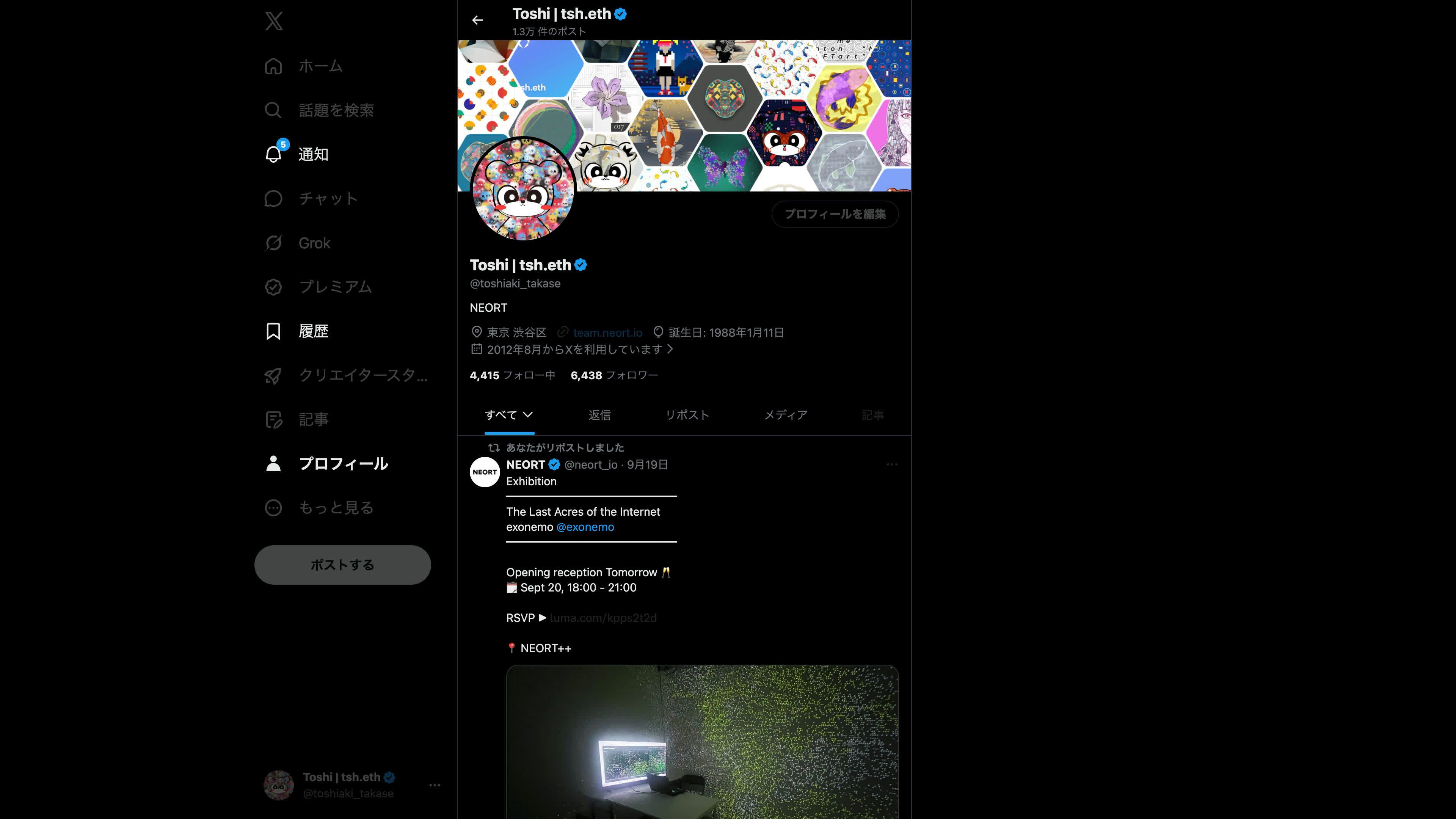
@toshiaki_takase: Room(シリーズ "@toshiaki_takase" より)
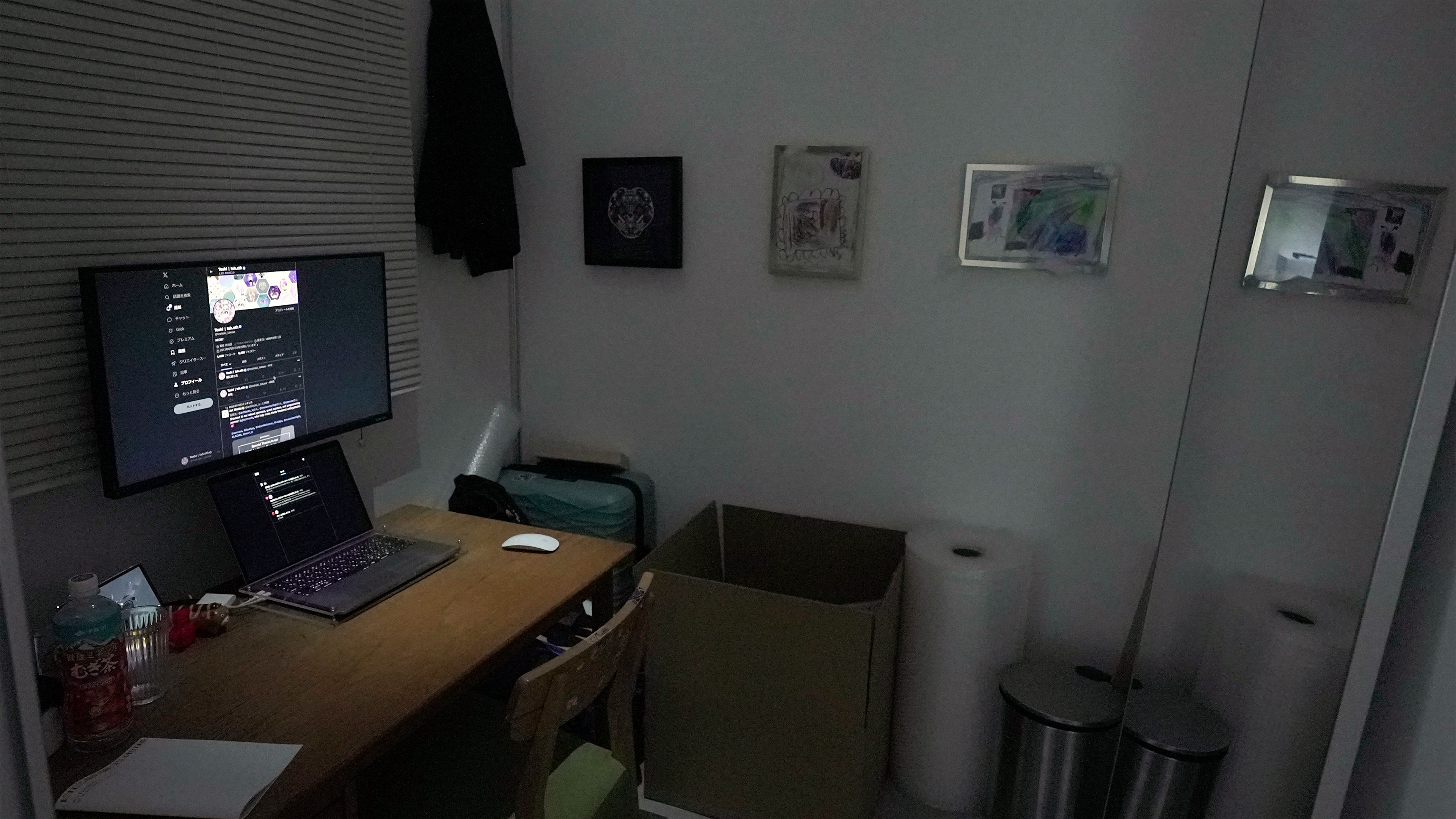
View artwork"@toshiaki_takase" is an artwork series that handles the X account Toshi has been using since 2012, presenting it in a state where others can delete parts of the account's information. And in the Room, the actual x.com page, logged in by Toshi himself, is displayed at the venue. Visitors can delete posts and undo likes, reposts, follows, and bookmarks. Nothing can be added, and no permission is required to delete.
In the era after generative AI, posts accumulated on social media are no longer materials that represent who a person is. Even though the account continues to exist, that person is not there. This is a death of identity in online space caused by accumulation no longer guaranteeing the person, which is different from physical death or forgetting.
In addition, each piece of deleted information leaves behind a 32-byte trace, which is stored on a smart contract.
Artists
荒川零一 | Zeroichi Arakawa
Code Poet, Smart Contract Engineer.
Finding literary and structural beauty in program code, Zeroichi continues to explore and experiment with the values that emerge from code as a medium. Representative works include 《DeepSea》, which explores internal states through testing frameworks, and 《inside window》, which excavates poetic spaces hidden within the browser runtime environment. These works present both the importance of reading code itself and the poetic experiences generated through its execution. Currently pursuing a PhD at the Institute of Advanced Media Arts and Sciences (IAMAS).
exonemo
exonemo is a Japanese artist duo comprised of Kensuke Sembo and Yae Akaiwa. Currently based in New York, exonemo began its activities on the Internet in 1996. Since then, they have been expressing human physicality and emotions in the network age through critical and humorous approaches, crossing digital and analog media. Their awards include the Golden Nica at Ars Electronica (2006) or the Agency for Cultural Affairs’ Art Encouragement Prize for New Artists (2021), receiving recognition from both the media art and contemporary art fields. They have exhibited online at the Whitney Museum of American Art (2019) and in a major solo exhibition at Tokyo Photographic Art Museum (2020), as well as in many other international exhibitions. Their other activities include "The Internet Yami-Ichi," an event they launched in 2012, has resonated with the Internet generation and spread to more than 30 cities worldwide, and has been featured by major international media such as The New York Times, The Guardian, and Libération.
久保田晃弘 | Akihiro Kubota aka hemokosa
Human. Publications include "The Disappearing Computer" (Iwanami Shoten, 1999), "Design for Distant Others" (BNN, 2017), "Principles of Media Art" (co-edited with Minoru Hatanaka, Film Art, 2018), "Quantum Computer Art Studies" (2025), "Random Rain 2025" (co-created with Reiichi Arakawa, 2025), "Not Here, Not Now", and "Artificial Aesthetics" (BNN, supervised, 2026). Recipient of the 66th Minister of Education, Culture, Sports, Science and Technology's Art Encouragement Prize (Media Arts Division). Professor Emeritus at Tama Art University.
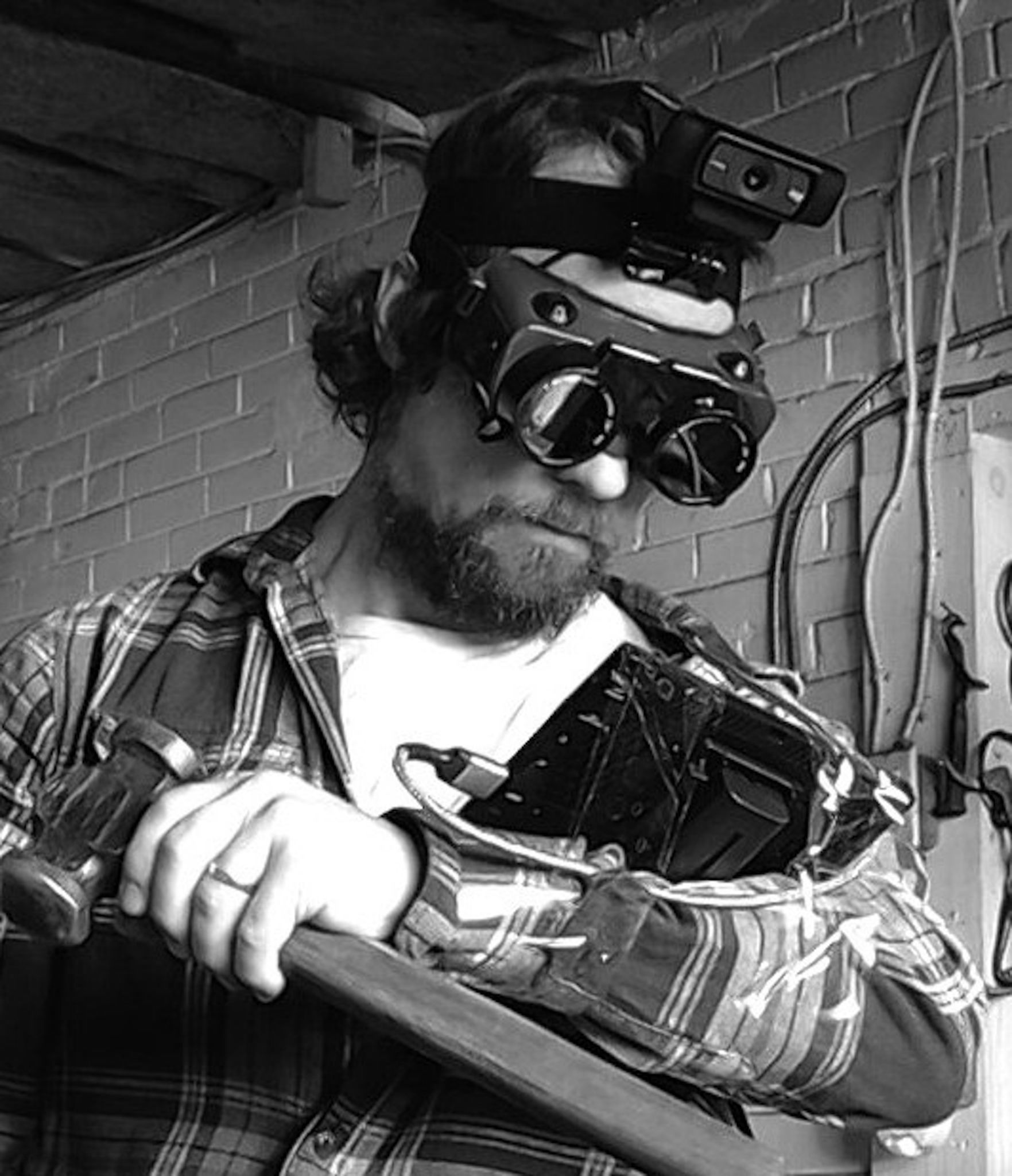
0xDEAFBEEF
0xDEAFBEEF is an artist and engineer based in Toronto, Canada. Over the past 20 years he has been tinkering in diverse areas overlapping art and technology including music, sound recording, computer animation, blacksmithing and generative art. He received his BASc in electrical engineering and MSc from the University of Toronto, where he contributed to internationally recognized research in the field of computer animation.
As a classically trained musician with a strong background in sound technology, he brings together all his interests in a bespoke art practice, using low level computer code and a minimal toolset to craft raw information into audiovisual artworks. His recent generative works explore the affordances of programmable blockchain technologies.

0xfff
0xFFF is a pseudonymous artist working with computation as material. Their work has been shown at Rhizome World and Basel Social Club, and they curated World Computer Sculpture Garden, an exhibition of programs that was itself a program. They make long-running works that execute autonomously — treating computation not as a tool but as the thing itself.
Toshi
Since the birth of blockchain technology, I have created works dealing with smart contracts, their standards, and forms of organization. My works include "The Ten Thousand" (2022), a contract that satisfies only the minimum conditions required to be displayed as an NFT; "OpenTransfer" (2022), a token that can be transferred by anyone; and "PlayTrain" (2023–24), which connects ENS subnames to form a single train. Through tiny interventions in standards, I have continually questioned what underpins digital ownership and identity.
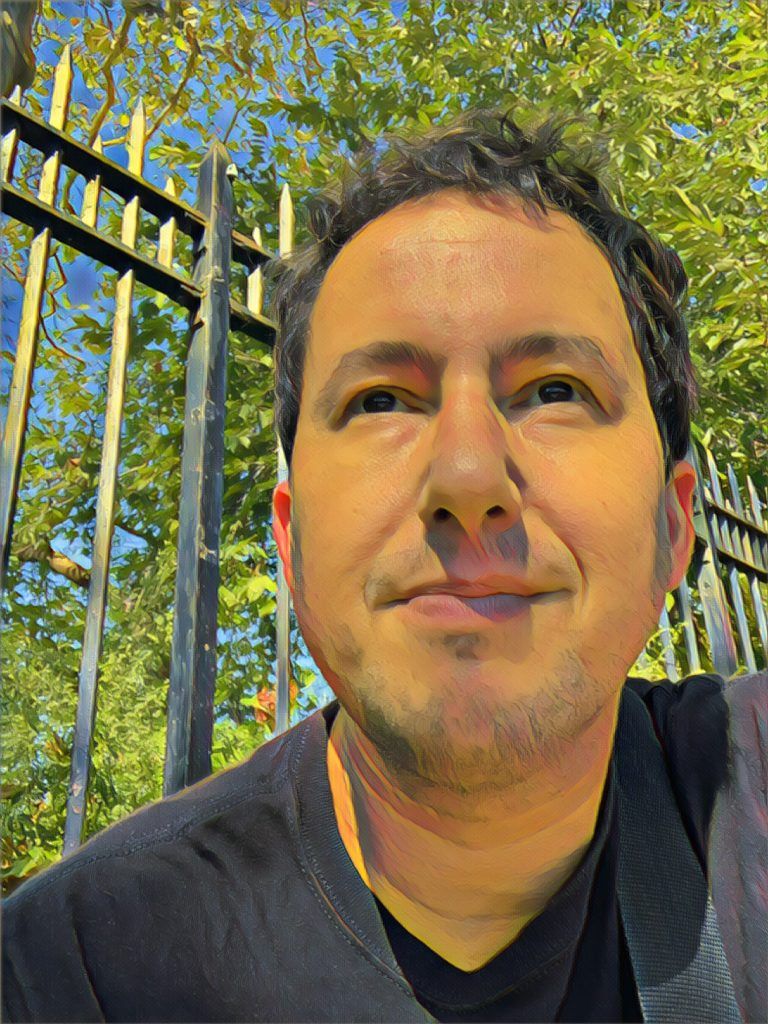
Jonah Brucker-Cohen
Jonah Brucker-Cohen is an artist, writer, and Associate Professor at Lehman College / CUNY. He received his Ph.D. from Trinity College Dublin and his artwork has been exhibited at venues such as SFMOMA, Canadian Museum of Contemporary Art, MOMA, ZKM Museum, ICA London, Whitney Museum of American Art, Palais du Tokyo, Tate Modern, Ars Electronica, Transmediale, and more. His writing has appeared in publications such as WIRED and Make and his Scrapyard Challenge workshops have been held in over 15 countries on 5 continents.