Satoshi Aizawa
Disturbed Memory
Editions are sold one at a time by serial English auction on Art Blocks. Each edition lives from the opening of its auction until the winning bid is settled.
エディションは Art Blocks のシリアル・イングリッシュ・オークションで1点ずつ販売されます。各エディションはオークション開始から落札確定まで生きます。
The memory of this machine holds a 256-character text, copied 32 times. Each flip below is one bit of it that changed on its own: which character, in which copy, which of its 8 bits, and how strong the radio was at that moment.このマシンのメモリには、256文字の文章が32回くり返して書き込まれています。下の反転は、そのうち1ビットがひとりでに変わったものです。何文字目の、何番目の写しの、どのビットか、そしてそのときの電波の強さを示します。
Latest flips直近の反転
Reading itself, it wears itself away.自己を読むことで、自己が損なわれてゆく。
This work takes as its subject the bit flips that occur in a computer's volatile memory (DRAM) under particular patterns of access. The very act by which the memory controller reaches into the rows and columns of memory becomes the source of its generation. It is, in this sense, a hybrid of hardware and software.
When the machine is powered on, the program begins automatically, and information about the machine itself is stored in its memory. The machine then begins to read that information back, as a memory of itself. DRAM holds its data in cells arranged in rows and columns. Normally a row is opened, the needed columns are accessed, and the row is closed; here, the row is held open orders of magnitude longer than usual before it is closed. Charge then leaks little by little from the cells of the neighbouring rows until, somewhere in a column, a bit flips.
This process, in which reading itself wears away the information it holds about itself, unfolds slowly over time: an instruction sets it in motion, and the charge receives it as a disturbance.
Source text and radio
The source text is a 256-byte string made of Linux commands actually run on the machine. It uses 96 characters, those typed on a US keyboard plus space and newline, and comes to 2,048 bits. One row of memory is 8,192 bytes, exactly 32 copies of the text, so the repeated text fills it with nothing left over.
In keeping with the concept of the exhibition, the work uses the strength of the Wi-Fi signal (RSSI), which shifts with the positions and movements of people in the room and with the materials and structure of the building. The more the signal is blocked, the more likely a row prone to flipping is chosen. When the signal changes sharply, the text is stored shifted out of place; when the change stalls, the latest shift is kept.
Overstrike
As bits flip, the characters of the text change. A character map of the artist's own design assigns a character to every possible value, so whatever value a flip produces can be shown as a character, and spaces and newlines appear in about the same proportion as in the source text.
When a character changes, the new one is struck over the old. After overstrike, the typewriter technique of striking one character over another, the text is set in a bitmap font made from a typewriter face. With every overstrike, each dot of a glyph counts how many times it has been struck, and shows that count in binary as stripes of white and black within the dot itself. In the animation, each dot is cut into as many horizontal stripes as its count has binary digits; where dots overlap, they show the sum of their counts (returning to 0 at 64) and go back to their own counts when they part. It counts 64 values, 0 to 63, and returns to 0 on the 64th strike, matching the way the whole process starts over when the machine restarts, and the 64 editions of the work.
The work uses only black and white: text is black on even-numbered editions and white on odd-numbered ones. Dots and glyphs flip in the direction of a turning page, forward as the animation plays and back as it rewinds. Still images (PNG), numbered frames for video (PNG) and the font itself (TTF) can be exported, using the artist's own implementation of each file format, from assembly to compression, with no external libraries.
Memory
The flips are stored on the blockchain in the order they occurred, then read and visualised in the browser.
About the making
The bit flips in this work are observed only in the memory of equipment owned by the artist; they do not interfere with anyone else's devices, networks or systems. The observation uses methods and code published as university research, and these methods are used for no purpose other than the work.
Font: Richard Polt, "Fox Understroke" (CC0). Research: Kim et al., ISCA 2014; Pessl et al., USENIX Security 2016; Frigo et al., IEEE S&P 2020; Hassan et al., MICRO 2021; Luo et al., ISCA 2023; Yüksel et al., MICRO 2025; Wang et al., DSN 2026.
本作は、コンピューターの揮発性メモリ(DRAM)において、特定のアクセスパターンのもとで発生するビット反転を主題としています。メモリコントローラーによるメモリの行と列へのアクセス、それ自体を生成のソースとしている、言わばハードウェアとソフトウェアのハイブリッド作品です。
実機の電源が入れられると本プログラムが自動的に開始され、実機自身に関する情報がメモリ内に格納されます。実機はその情報を自分自身に関する記憶として読み出しはじめます。DRAM はデータを行と列に並んだセルの中に保持しており、読み書きの際には通常、まず目的の行を開き、必要な列にアクセスしそして閉じる、という動作が行われますが、ここでは通常より桁違いに長く開いたまま保持してから閉じる、という動作が行われます。この時、開かれた行の隣の行のセルから電荷が微量ずつ漏れてゆき、最終的に、そのどこかの列に格納されているビットが反転する、という事象が発生します。
自己を読むことで自己に関する情報が損なわれてゆくこのプロセスは、命令が起こし電荷が受ける(擾乱される)という形で、時間とともにゆるやかに進行してゆきます。
原文と電波
原文として、実機で実際に実行された Linux コマンドからなる 256 バイトの文字列を用意しました。US キーボードで入力できる文字・記号に、スペースと改行を加えた 96 種の文字からなり、全体で 2048 ビットになります。メモリの 1 行は 8192 バイトで原文 32 回分にあたり、原文を繰り返すとちょうど収まります。
本展のコンセプトに合わせ、展示会場での人の位置や動き、建物の材質や構造によって変化する電波強度(RSSI)を用いています。電波が遮られている度合いが高いほど、反転が出やすい行が選ばれやすくなります。電波の変化が大きいときには原文がずれた状態でメモリに格納され、変化が停滞しているときは直近のずれが保たれます。
重ね打ち
反転したビットに合わせて、原文の文字が変化します。反転によってどの値になっても文字として表示できるよう、ビット空間のすべての値を文字に割り当てた独自の文字マップを用いており、スペースと改行は原文とほぼ同じ比率で現れます。
文字が変化すると、新しい文字はそれまでの文字の上に打ち重ねられます。タイプライターで文字を重ねて打つ手法 Overstrike にちなみ、タイプライターフォントをもとにしたビットマップフォントで表示しています。重ね打ちのたびに、グリフの各ドットが重ねられた回数が数えられ、その回数が白と黒の縞による 2 進数でドット自身に表されます。アニメーション中は、各ドットが打たれた回数の桁数と同じ数の横縞に切り分けられます。また、他のドットと重なっている間はそれぞれの回数を足した値(64 で一巡)を示し、離れるとそれぞれの回数に戻ります。数えられるのは 0 から 63 までの 64 通りで、64 回目で 0 に戻ります。これは、実機を再起動すると一連のプロセスが最初から始まる性質と、エディションの総数が 64 であることに合わせたものです。
色は白と黒のみで、エディション番号が偶数なら文字は黒、奇数なら白になります。アニメーションでのドットやグリフの反転の向きは本のページをめくる向きに合わせており、再生では次のページへ、巻き戻しでは前のページへ進みます。静止画(PNG)、動画用の連番画像(PNG)、フォント(TTF)を書き出すことができ、その書き出しには外部ライブラリを使わず、ファイル形式の組み立てから圧縮までを独自に実装しています。
記憶
反転の情報は、起きた順序のままブロックチェーン上に保存され、ブラウザで読み込まれて視覚化されます。
制作について
本作のビット反転の観測は、作者が所有する機材のメモリ上でのみ行われており、他者の機器やネットワーク、システムに干渉するものではありません。観測には大学の研究として公開されている手法とコードを用いており、その手法を作品表現以外の目的に用いるものではありません。
フォント:Richard Polt「Fox Understroke」(CC0)。参考研究:Kim et al., ISCA 2014/Pessl et al., USENIX Security 2016/Frigo et al., IEEE S&P 2020/Hassan et al., MICRO 2021/Luo et al., ISCA 2023/Yüksel et al., MICRO 2025/Wang et al., DSN 2026。
Collected lifetimes.
コレクトされた時間。
- Collected
- 0 / 64
- Lived in total
- —
- Longest life
- —
Not yet born. It will open after 1 more auction.まだ生まれていません。あと 1 回のオークションの後に始まります。
Satoshi Aizawa
Satoshi Aizawa is a generative artist whose practice explores the aesthetic qualities that emerge from autonomous systems and algorithmic processes. His works are characterized by a minimalist visual language and carefully constructed mechanisms designed to reveal computational beauty in its purest form.
By deliberately excluding references to human culture and symbolic meaning, Aizawa invites viewers to engage with his works through fundamental perceptual experience. Among his best-known projects is the Path series, a collection of looping animations in which simple lines gradually construct geometric forms, originally released on Hic et Nunc.
Satoshi Aizawa は、自律的なシステムとアルゴリズムのプロセスから立ち現れる美的な質を探求するジェネラティブアーティストです。ミニマルな視覚言語と、計算の美をもっとも純粋なかたちで露わにするよう緻密に構築された仕組みを特徴とします。
人間の文化や象徴的な意味への参照を意図的に排することで、鑑賞者を根源的な知覚の経験へと誘います。代表作に、単純な線が少しずつ幾何学的な形を組み上げていくループアニメーションのシリーズ「Path」があり、Hic et Nunc で発表されました。
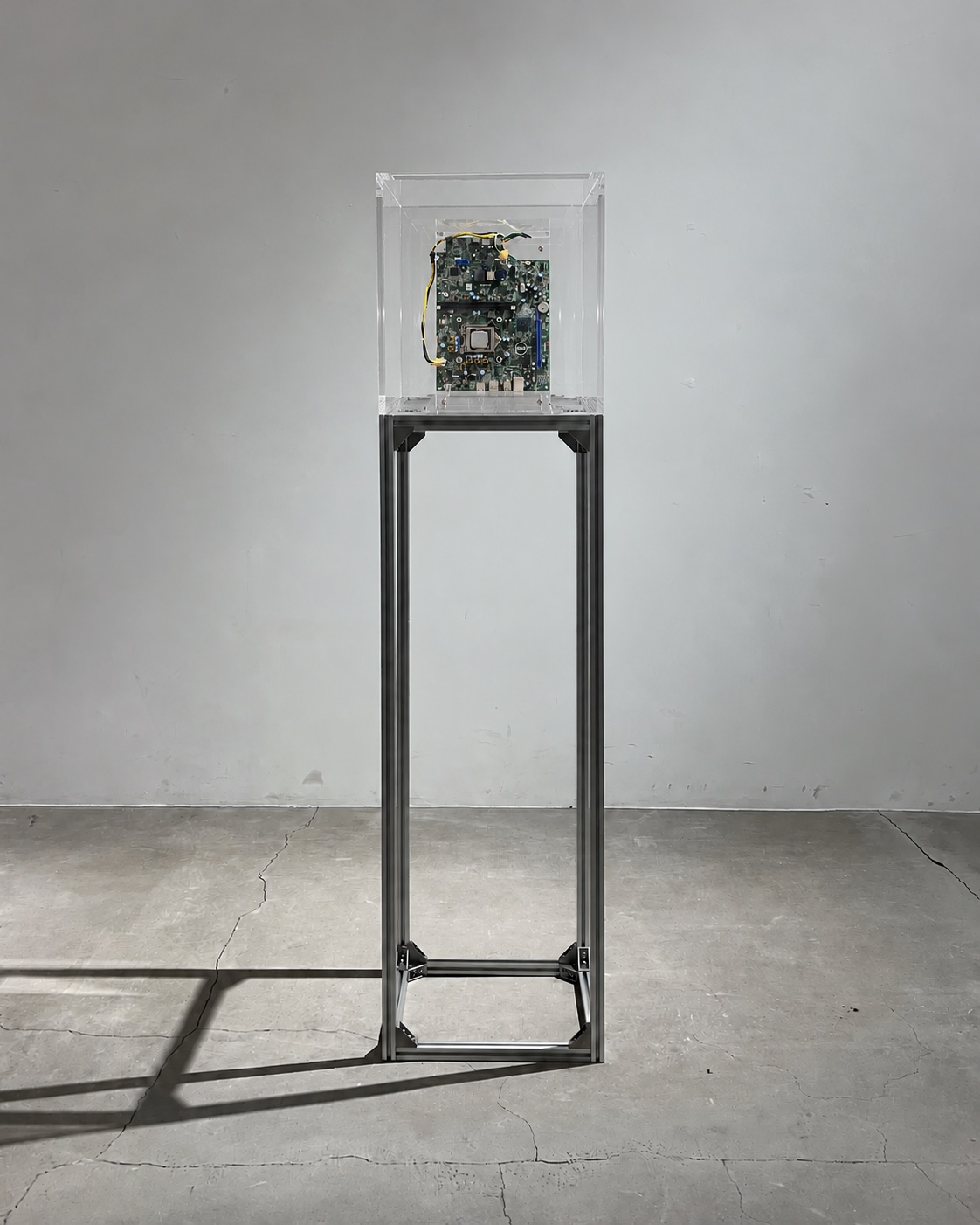
Disturbed Memory1 / 1
The machine itself, which has computed every edition of Disturbed Memory, sealed in its transparent cube on its stand. One unique physical work.
この作品のすべてのエディションを計算してきたマシンそのもの。透明なキューブに収められ、スタンドと一体になった、ただ一つのフィジカル作品です。
- Edition
- Unique (1/1)1点もの(1/1)
- Medium
- Machine, acrylic cube, aluminium standマシン、アクリルキューブ、アルミスタンド
- Dimensions
- —
- Status
- To be announced近日発表
What comes with the machine.マシンに付属するもの
Each machine is accompanied by a documentation package prepared in accordance with the Matters in Media Art (MIMA) protocol, the conservation standard for time-based media art developed jointly by MoMA, SFMOMA and Tate. It covers acquisition, documentation, loan and long-term preservation.
各マシンには、MoMA・SFMOMA・テートが共同で策定したタイムベース・メディアアートの保存標準「Matters in Media Art(MIMA)」に準拠したドキュメント一式が付属します。収蔵、記録、貸し出し、長期保存までを扱います。
- 01
The machineマシン本体
The machine in its transparent acrylic cube, 32 cm on a side, on its aluminium stand. Every component is tested before delivery.
外寸32cmの透明なアクリルキューブに収められたマシンと、アルミのスタンド。お渡しの前にすべての部品を点検します。
- 02
Certificate of Authenticity証明書
Signed by the artist. Records the machine, the work, its editions on Art Blocks and the date of production.
作家の署名入り。マシン、作品、Art Blocks 上のエディション、制作日を記録します。
- 03
Identity Reportアイデンティティ・レポート
An artist-authored statement of what makes the work the work: the machine, the code it runs and the signals it reads, and which parts may be serviced or replaced in future without loss of authenticity.
作品を作品たらしめるものを作家自身が定める文書。マシン、動かしているコード、読み取る信号のうち、何が本質で、何が将来の保存で修理や交換をしても真正性を損なわないかを明らかにします。
- 04
Installation Instructions設置の手引き
Placement, power, network connection for the live data, ambient conditions and safe handling.
置き方、電源、ライブデータのためのネットワーク接続、推奨される環境、取り扱いの注意。
- 05
Source Code Archiveソースコードのアーカイブ
The machine's measurement and generative code on archival media, the reference for any future conservation, migration or re-implementation.
マシンの計測と生成のコードを保存用メディアに収めたもの。将来の保存、移行、再実装のための基準になります。
- 06
Copyright License著作権の許諾
Grants the collector the rights to display, lend and make preservation copies of the work, including migration to equivalent hardware.
作品の展示、貸し出し、保存のための複製について、同等のハードウェアへの移行を含めてコレクターに許諾します。
- 07
Conservation Notes保存のための覚書
Guidance on the life of the hardware, the policy for replacing components, recommended inspection intervals and technical support.
ハードウェアの寿命、部品交換の方針、推奨される点検の間隔、技術的なサポートについての指針。
The documentation is being prepared and will be published here.
ドキュメントは現在準備中です。整い次第、ここに掲載します。