Passing
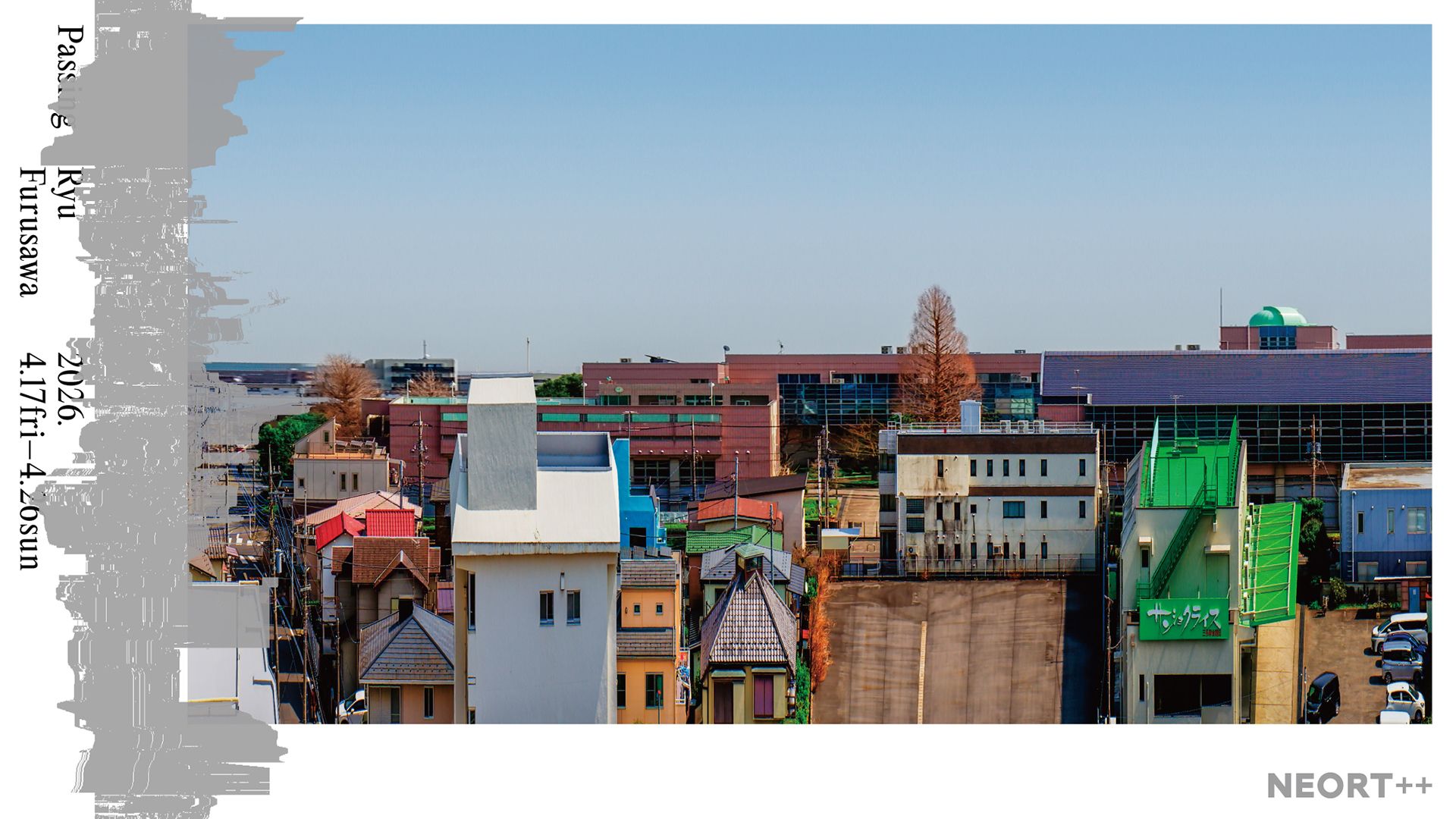
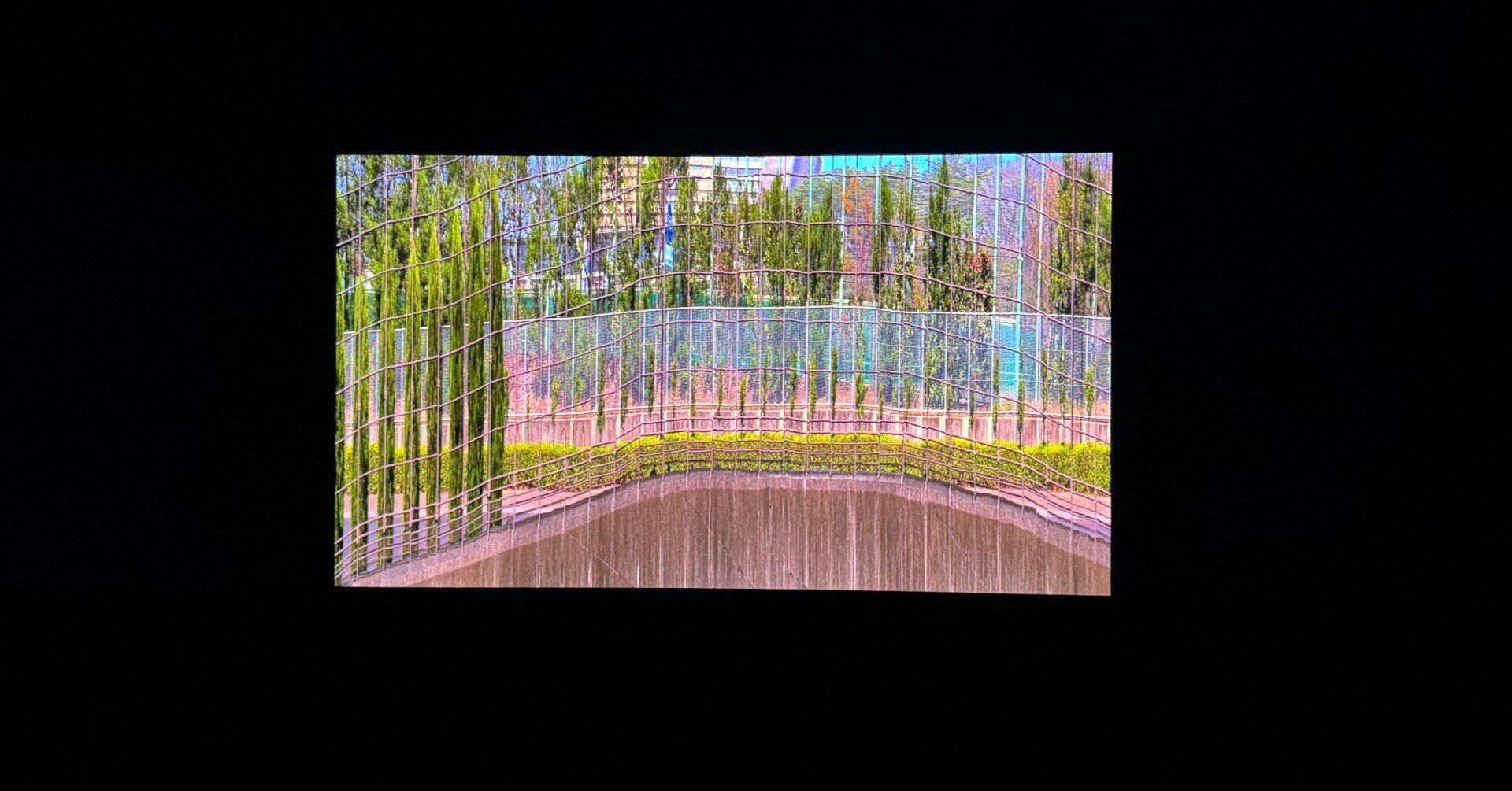
NEORT++ is pleased to announce the solo exhibition "Passing" by Ryu Furusawa.
Statement
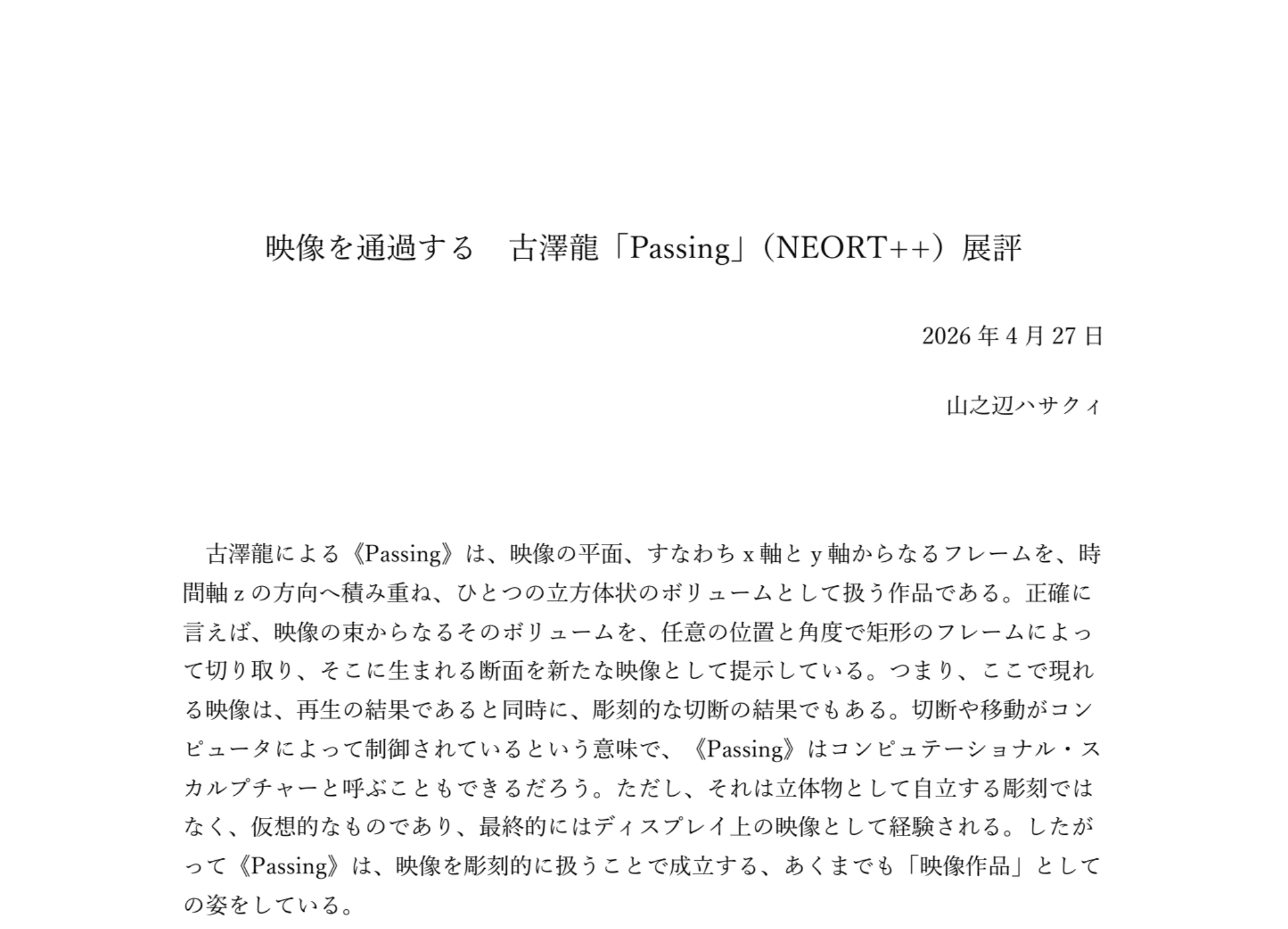
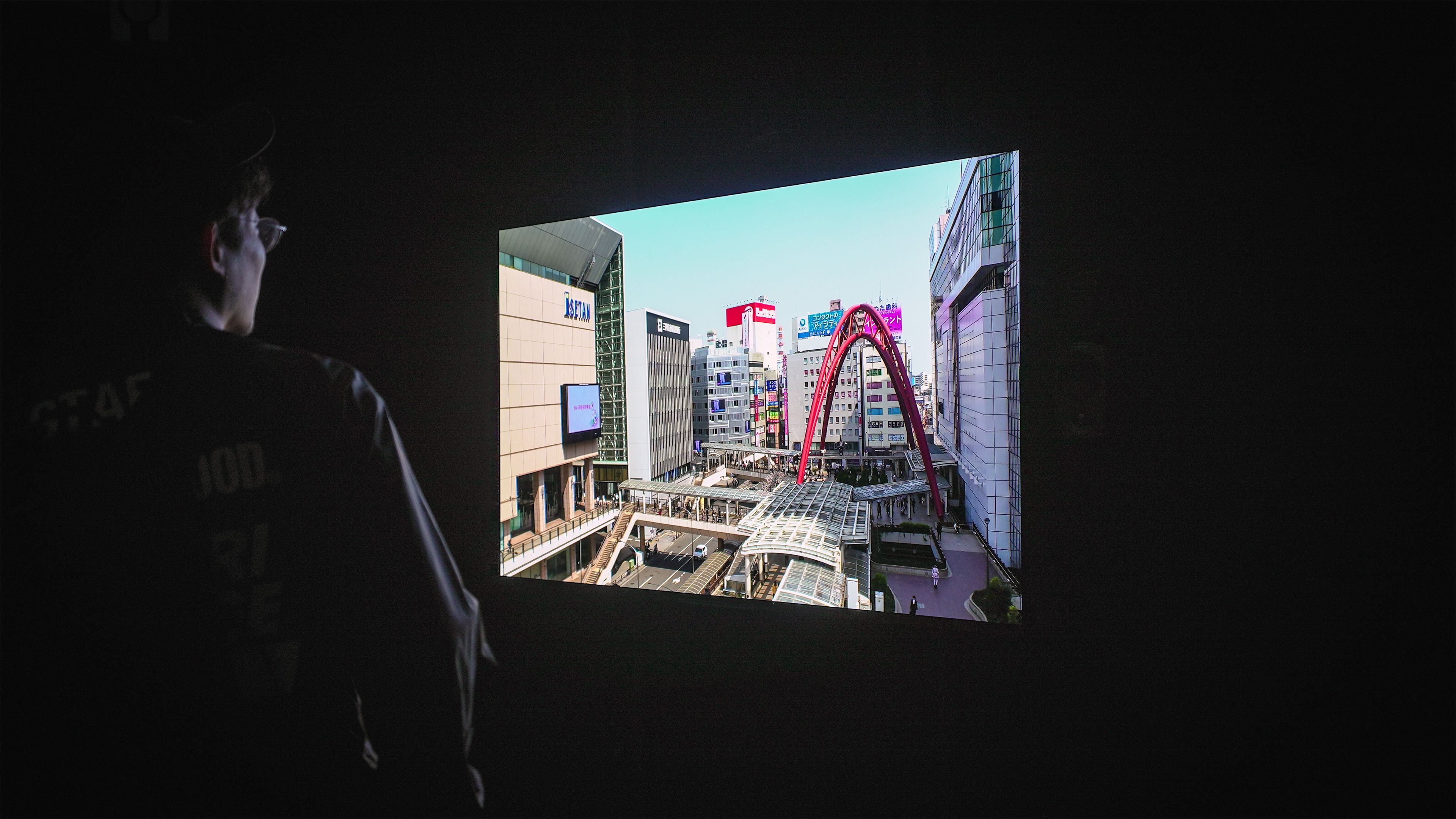
This exhibition presents Passing, a new work by Ryu Furusawa. Applying an original digital process to footage captured through a train window, the work transforms the very experience of time that "passing" entails.
When we gaze at a landscape from a moving train, depth emerges naturally from the flow before us. Nearby utility poles and buildings rush past; distant mountain ranges barely move. It is this gradient of speeds that constitutes our perception of depth. This mechanism rests on a premise: that the observer and the observed share the same three-dimensional space, and that time flows in a single direction. When that premise collapses — where do our perceptions of position, distance, speed, and time begin to drift?
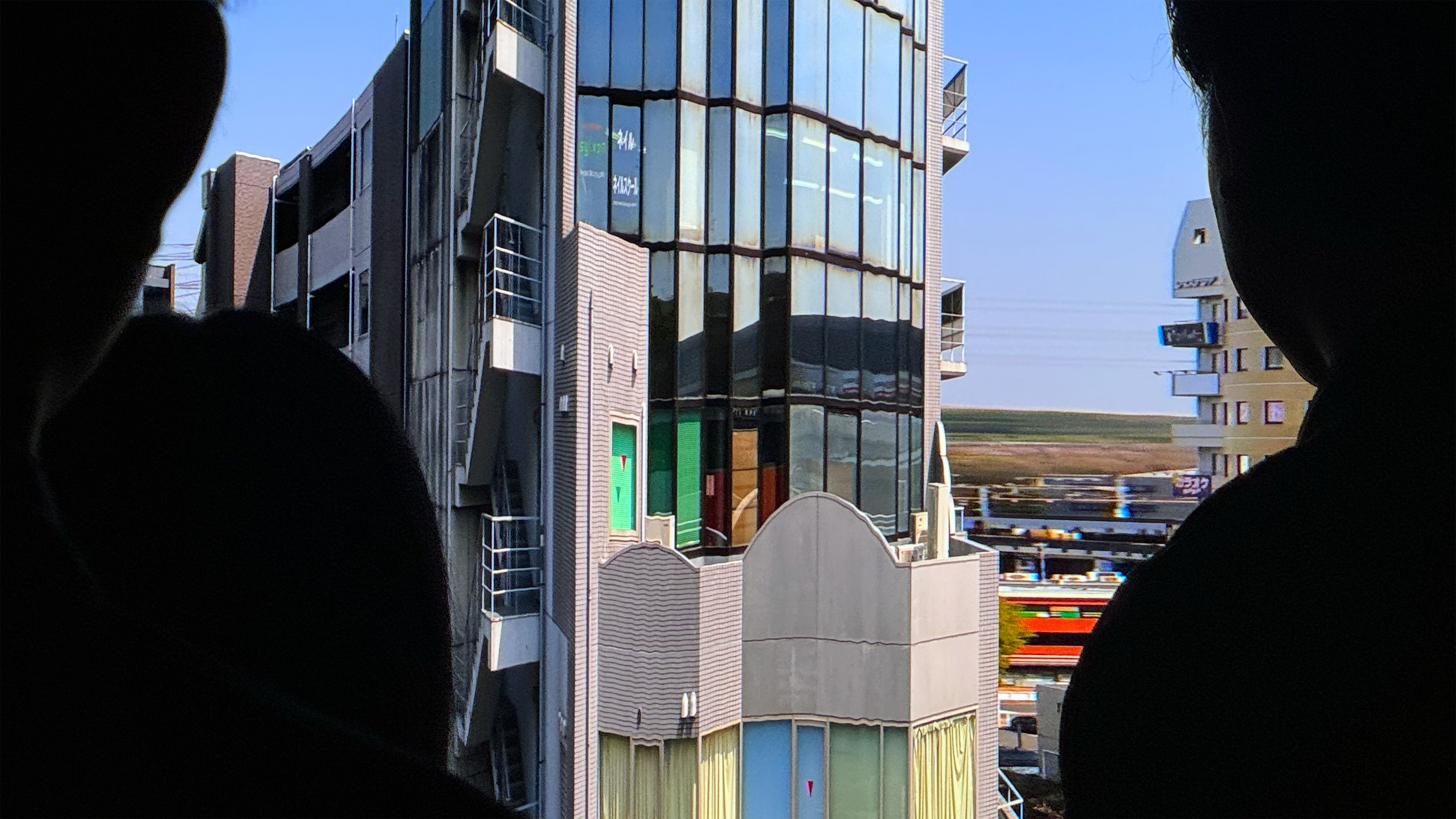
The digital process begins by giving the footage volume — treating the moving image as a series of still images stacked one behind the other. In conventional playback, this volume is traversed linearly by extracting cross-sections over time. In Passing, however, that angle is freely rotated. The simultaneity that once held within a single frame dissolves. The perspectival space converging toward a vanishing point gradually transforms, through the horizon as its axis, into a parallel projection where a single vanishing point gives way to the horizon itself. The order of space and time quietly comes undone.
Production Support: Sony Corporation
Grant Support: Kao Foundation for Arts and Sciences, Japanese Motion Graphic Creators - CREATOR GRANT, MAM, General Incorporated Association
Co-organizer: NEORT,Inc.
Organizer: Ryu Furusawa Exhibition Committee
Comments
The art historian Erwin Panofsky argued that the purely mathematical space produced by linear perspective in the Renaissance, an infinitely extending homogeneous space, operates according to a different order from the space humans perceive through psychophysiological experience, and that a certain ideology is at work in rationally systematizing space. Likewise, Jean-Louis Baudry, who led apparatus theory in cinema, argued that moving images based on the identification between the camera eye and the viewer also carry an ideology similar to that of linear perspective.
Furusawa’s new work Passing seems to attempt an intervention into this transparent ideology of vision that governs contemporary viewers, who are increasingly unable to systematize visual experience without relying on the framework of images or what might now be called the image-based condition itself.
Furusawa has often been evaluated from the angle of media art, yet his work has consistently extended into adjacent domains such as documentary and animation. This work as well can be understood as an inquiry into the essence of moving images. ── Daisuke Tanaka
By constructing images within a three-dimensional space and allowing a two-dimensional screen to move through it, generating new images, Furusawa’s unique rendering system felt to me like a new kind of camera. It gives the impression of filming already filmed images, producing a layered structure, and I was deeply moved by his approach of inventing from the level of the apparatus itself.
From the perspective of production methods and visual expression, I found the work to be highly painterly despite being composed of moving images. Knowing that Furusawa studied Western painting, this quality felt entirely natural and convincing.
The exhibition seems likely to provide an opportunity to reconsider in depth the nature of moving images as a medium with a temporal axis, and I am very much looking forward to it. ── NIINOMI
A train window is a moving frame. Within it, the near field rushes past violently, while the distant field remains almost still. We unconsciously translate this difference in speed into depth. In other words, in the view from a train window, speed becomes distance. Ryu Furusawa’s Passing unravels this structure. By giving an angle to a slice of time, the relationship between time and space begins to waver, and multiple times start to coexist within a single space. The landscape appears before our eyes as the thickness of passing time. The passing view no longer simply passes. It is folded within time, layered, and transformed into duration. ── Yusuke Shono
Artworks
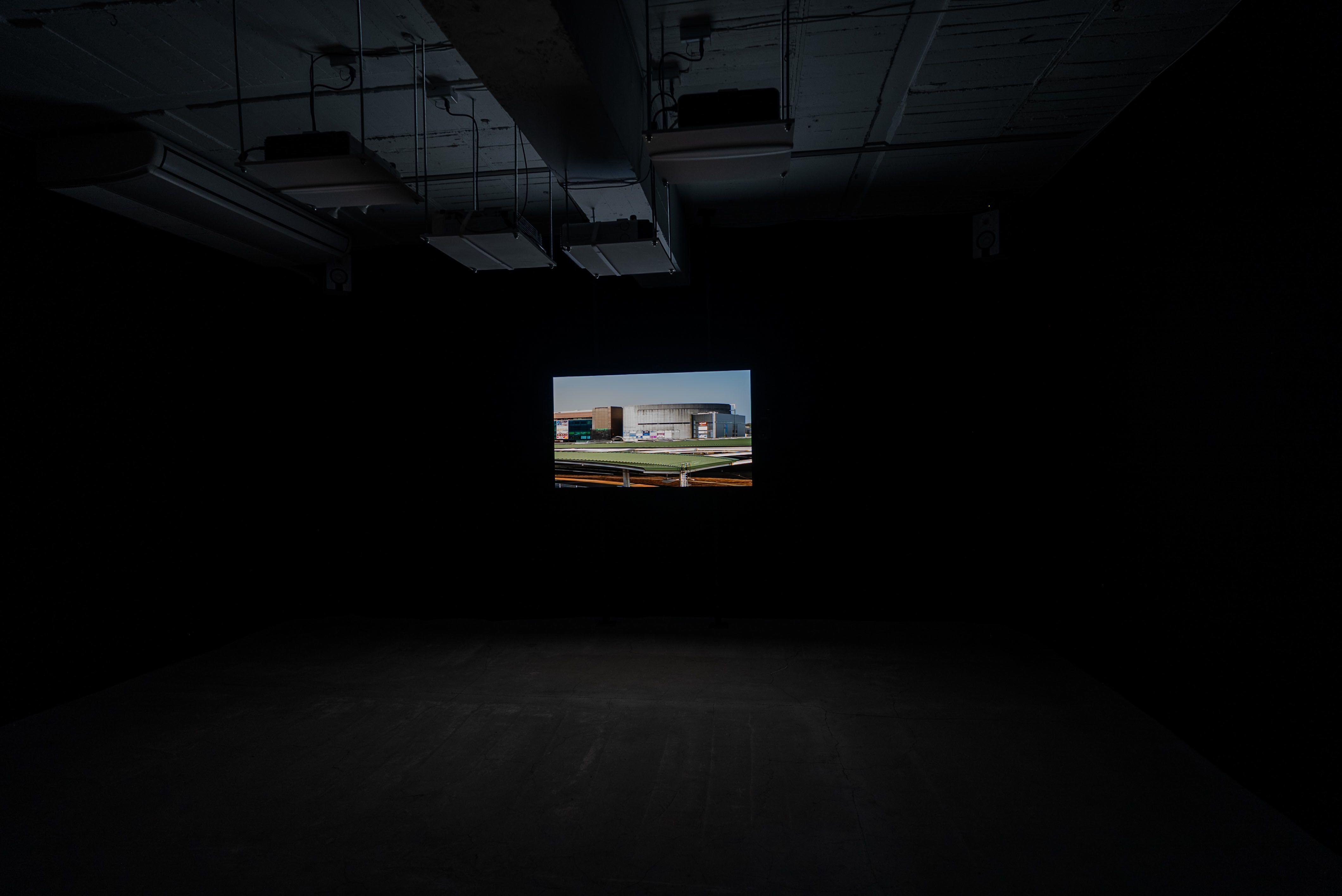
Passing
View artworkOn March 27, 2025, the landscape between Tachikawa and Tama Center was recorded with a high-resolution high-speed camera through the window of the Tama Monorail in western Tokyo. Taking this single recording as its source material, this work rewrites the temporal and spatial structure of the image through digital coordinate transformation, thereby transforming the very temporal and spatial experience of 'passing' itself.
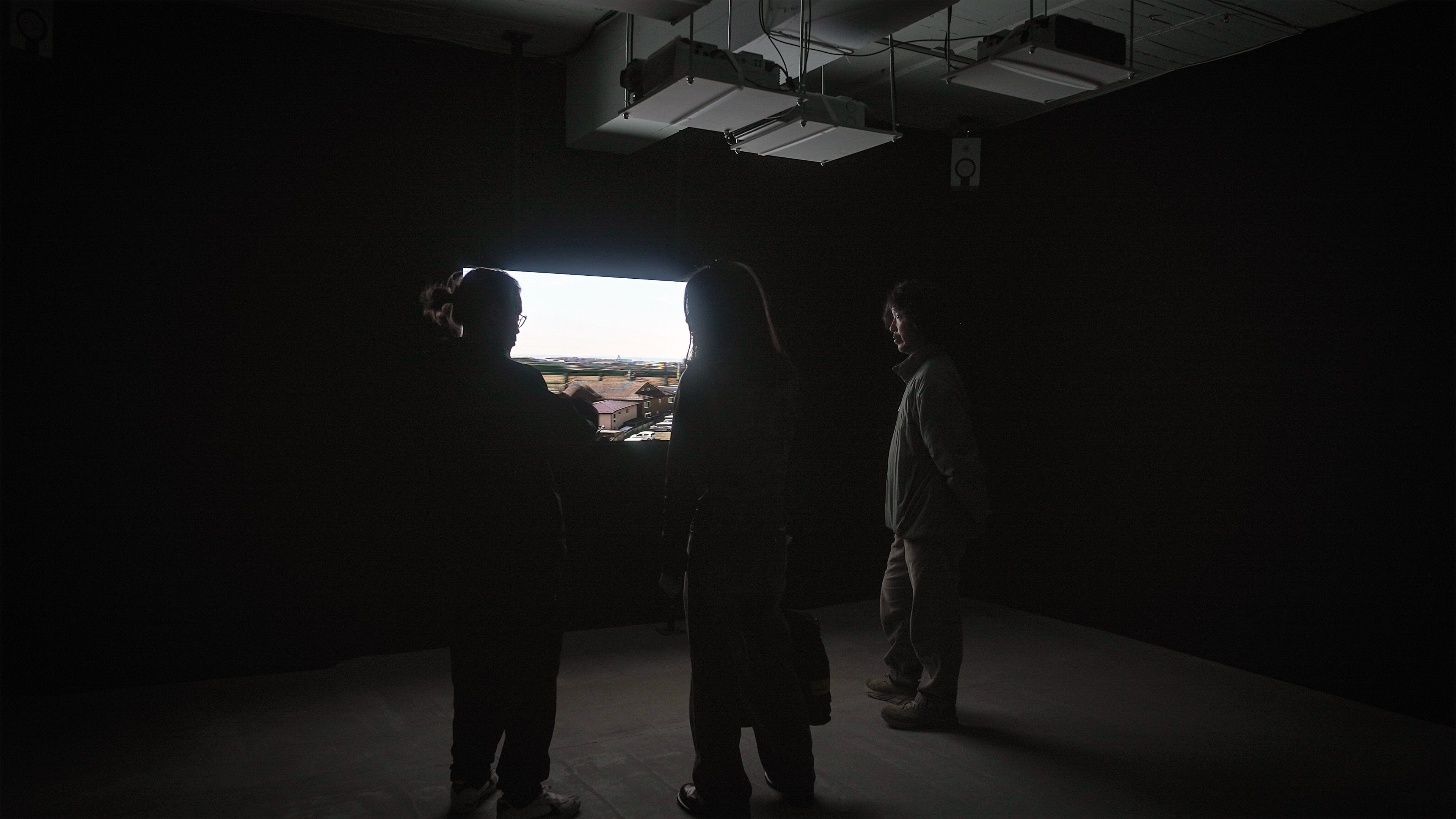
Rendered through continuously varying timings and parameters, streams of transformed footage play on seamlessly, their paths shifting in response to the viewer's act of 'watching' or 'not watching' the screen. Responding to this non-linear generation, the sound is produced in real time through an AI model.
Carrying its contradictions within, the landscape flows endlessly on — from left to right, without cease.
In time, this flow quietly works upon the viewer's perception, and the relations between distance, speed, and time gradually come undone.
Artist
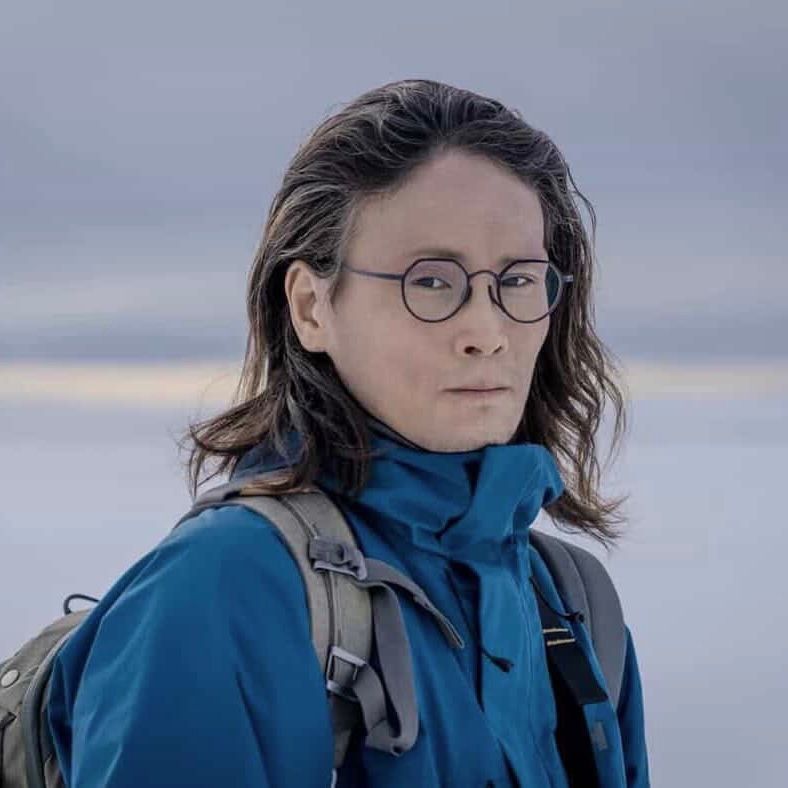
古澤龍 | Ryu Furusawa
Ryu Furusawa is an artist based in Tokyo and Chiba. Through the manipulation of the medium and the viewing environment itself, he seeks to generate an ambiguous state across the picture plane, in which the boundary between subjectivity and objectivity wavers. Recent practice centers on an approach that combines recorded moving images with digital coordinate transformation to rewrite the time and space within them. Through the medium's capacity to imitate temporal experience and interventions into its structure, he continues to explore alternative ways of grasping the perception of time and space—frameworks that have been formed and taken for granted by the institutions and conventions of visual media.
Selected awards include Honorary Mention, Prix Ars Electronica 2024 and the 25th Japan Media Arts Festival Art Division Jury Selection. Selected exhibitions include mission ∞ infinity | space + quantum + art (Museum of Contemporary Art Tokyo, 2026), Rear Window & Real Wonder (HOW Art Museum, Shanghai, 2025), and ICC Annual 2024 (NTT InterCommunication Center, Tokyo, 2024). He is also a member of the artist collective YOF.
Events
- ended2026.4.17 09:00 _ 2026.4.17 12:00
"Passing" オープニングレセプション
We will pleased to hold an opening reception for exhibition "Passing". No reservation is necessary and everyone is welcome. maruka 3F, Nihonbashi Bakurocho 2-2-14, Chuo-ku, TokyoOn Site
Reviews